
Fezolinetant
- CAS NO.:1629229-37-3
- Empirical Formula: C16H15FN6OS
- Molecular Weight: 358.39
- MDL number: MFCD30532641
- Update Date: 2026-07-23 14:48:42
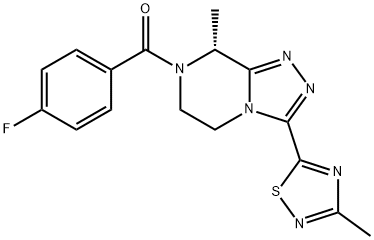
What is Fezolinetant?
Absorption
In healthy women, fezolinetant Cmax and AUC increased proportionally over a dosage range from 20 to 60 mg once daily (0.44 to 1.33 times the approved recommended dosage). Steady-state plasma concentrations of fezolinetant were reached after two once-daily doses, with minimal fezolinetant accumulation. The median (range) time to reach fezolinetant Cmax is 1.5 (1 to 4) hours in healthy women.
Toxicity
In embryo-fetal development toxicity studies in rats and rabbits, embryo-lethality was noted at the highest doses (128- and 174-fold the human AUC24 at the human therapeutic dose for rats and rabbits, respectively). The no observed adverse effect level (NOAEL) for embryo-fetal development was 50 mg/kg/day in rats and 45 mg/kg/day in rabbits (62- and 16-fold the human AUC24 at the human therapeutic dose for rats and rabbits, respectively). Fezolinetant showed no effects on fertility and early embryonic development in rats.
In the pre-and post-natal development study in rats, the NOAEL for maternal and fetal toxicity was 30 mg/kg/day (36-fold the human AUC24 at the human therapeutic dose) based on delayed parturition and embryo-lethality at 100 mg/kg/day. The NOAEL for F1 generation development was determined to be 100 mg/kg/day for females (204-fold the human AUC24 at the human therapeutic dose) and 10 mg/kg/day for males (11-fold the human AUC24 at the human therapeutic dose).
In the pre-and post-natal development study in rats, the F1 male showed incomplete balanopreputial separation at doses greater than or equal to 30 mg/kg/day (36-fold the human AUC24 at the human therapeutic dose), which delayed male reproductive maturation and affected fertility. These effects were not observed following dosing at 10 mg/kg/day (11-fold the human AUC24 at the human therapeutic dose).
Repeat dose toxicity studies were conducted in intact female rats and cynomolgus monkeys. In female rats, daily administration of fezolinetant for 26 weeks at doses equal to or greater than 30 mg/kg/day (56-fold the human AUC24 at the human therapeutic dose) showed uterine atrophy and epithelial mucification of the vagina and cervix. In female cynomolgus monkeys, daily administration for 39 weeks at doses equal to or greater than 10 mg/kg/day (19-fold the human AUC24 at the human therapeutic dose) showed reduced ovarian activity.
Fezolinetant is contraindicated in individuals with severe (eGFR 15 to less than 30 mL/min/1.73 m2) renal impairment or end-stage renal disease (eGFR less than 15 mL/min/1.73 m2). No dose adjustment of fezolinetant is recommended for individuals with mild (eGFR 60 to less than 90 mL/min/1.73 m2) or moderate (eGFR 30 to less than 60 mL/min/1.73 m2) renal impairment.
Child-Pugh Class A or B hepatic impairment increased the exposure to fezolinetant. Fezolinetant has not been studied in individuals with Child-Pugh Class C hepatic impairment.
In a 2-year female rat carcinogenicity study and a 26-week carcinogenicity study in rasH2 transgenic mice, there was no evidence of drug-related carcinogenicity at 186-fold and 47-fold the human AUC24 at the human therapeutic dose of 45 mg, respectively.
Fezolinetant showed no genotoxic potential by the bacterial reverse mutation test, chromosomal aberration test, or in vivo micronucleus test.
Treatment of overdose consists of discontinuation of fezolinetant therapy with the institution of appropriate symptomatic care.
The Uses of Fezolinetant
Fezolinetant is an antagonist of the neurokinin 3 receptor (NK3R), used for the treatment of menopausal hot flushes.
Background
Vasomotor symptoms (VMS), more colloquially known as hot flashes or night sweats, are the most common symptoms, if not the cardinal symptoms, in women. With a median duration of 7.4 years, vasomotor symptoms are also the most common reasons why women seek treatments for menopausal issues. Although mostly considered a nuisance, vasomotor symptoms could potentially affect the quality of life, as women with 7 or more daily moderate to severe VMS reported a decline in sleep quality, concentration, sexual activity, energy, and concentration.
Although the pathophysiology of VMS is not fully understood, unpredictable fluctuation of estrogen level is thought to be the main cause of VMS, as estrogen therapy has been one of the most effective treatments for VMS by relieving symptoms in as many as 95% of menopausal women. Women undergoing abrupt menopause due to oophorectomy also experienced more severe symptoms than those going through a gradual transition. Additionally, thermoregulatory dysfunction has been proposed as one of the three possible mechanisms for VMS in menopause. Estrogen is a potent neuromodulator, particularly in the hypothalamus, and has been shown to be involved as a negative regulator in generating Gonadotropin-releasing hormone (GnRH) pulse through the kisspeptin, neurokinin B, and dynorphin (KNDy) neurons. NK3, one of the receptors expressed in KNDy neurons, is activated by neurokinin B and can thus induce the release of GnRH. Lower estrogen levels during menopause will decrease the estrogen-mediated feedback loop and increase neurokinin B signalling, increasing the activity of KNDy neurons and therefore the activity of the temperature control center. By antagonizing NK3 receptors, neuronal signalling can be dampened to reduce VMS.
Although hormone therapy is available for menopausal women, safety and tolerability concerns, such as an increased risk of stroke and venous thromboembolism or hormone-dependent cancer like breast cancer, can prevent some women from receiving this treatment. Fezolinetant, an NK3 receptor antagonist, was developed in response to this issue as well as more understanding of the role of NK3R in the hypothalamic-pituitary-gonadal (HPG) axis. Although previous NK3 receptor antagonists exist, such as osanetant and talnetant, only fezolinetant showed tangible effects on the HPC axis, potentially due to its favorable pharmacokinetics profile to cross the blood-brain barrier.
Fezolinetant is approved by the FDA in May 2023 under the brand name VEOZAH.
Indications
Fezolinetant is indicated for the treatment of moderate to severe vasomotor symptoms due to menopause.
Definition
ChEBI: Fezolinetant is a triazolopyrazine that is 5,6,7,8-tetrahydro[1,2,4]triazolo[4,3-a]pyrazine substituted by 3-methyl-1,2,4-thiadiazol-5-yl, 4-fluorobenzoyl and methyl groups at positions 3, 7, and 8R, respectively. It is a prescription medicine used to reduce moderate to severe vasomotor symptoms due to menopause. It has a role as a neurokinin-3 receptor antagonist. It is a member of monofluorobenzenes, a triazolopyrazine, a member of thiadiazoles, a member of benzamides and a tertiary carboxamide.
Pharmacokinetics
Fezolinetant has a high affinity for the NK3 receptor (Ki value of 19.9 to 22.1 nmol/L), which is more than 450-fold higher than the binding affinity for NK1 or NK2 receptors.
Treatment with fezolinetant did not show any clear trends in sex hormones measured (follicle-stimulating hormone, testosterone, estrogen, and dehydroepiandrosterone sulfate) in menopausal women. A transient decrease of luteinizing hormone (LH) levels was observed at peak concentrations of fezolinetant. At a dose 20 times the maximum approved recommended dose, fezolinetant does not prolong the QT interval to any clinically relevant extent.
In a phase 2a clinical trial, fezolinetant 90 mg BID significantly reduce the frequency and severity of vasomotor symptoms in postmenopausal women by more than 50%. The improvement was observed as early as in the first week of treatment and was maintained throughout the 12 weeks of treatment.
Metabolism
Fezolinetant is primarily metabolized by CYP1A2 and to a lesser extent by CYP2C9 and CYP2C19. A major metabolite of fezolinetant, ES259564, was identified in plasma. ES259564 is approximately 20-fold less potent than the parent. The metabolite-to-parent ratio ranges from 0.7 to 1.8.
Properties of Fezolinetant
| Boiling point: | 623.0±65.0 °C(Predicted) |
| Density | 1.56±0.1 g/cm3(Predicted) |
| storage temp. | Store at -20°C |
| solubility | DMSO:20.0(Max Conc. mg/mL);55.8(Max Conc. mM) |
| form | Solid |
| pka | -0.28±0.40(Predicted) |
| color | White to yellow |
Safety information for Fezolinetant
Computed Descriptors for Fezolinetant
Fezolinetant manufacturer
New Products
5-bromo-4-fluoro-2-nitrobenzaldehyde (R)-(-)-2-Amino-1-propanol Cyclobutanone Fmoc-OSu 1-(2-Chloroethyl)pyrrolidine Hydrochloride 2-Amino-2-(4-methylphenyl)acetic acid Obidoxime hydrochloride API Decanoic acid, 2-[4-(phenylmethoxy)phenyl]ethyl ester Piperazine, 1-(3-methoxyphenyl)-, hydrochloride (1:1) 4-Bromo-2,6-difluoroaniline 4 pentyn 1 ol N-Vinylformamide Methacrylate-PEG-Methacrylate, Mn:35000 2,4-Dihydroxyacetophenone 2-Chloro 5-Fluoro Pyridine Vasicinone 2-Chloroisonicotinic Acid Tween 80 or Polysorbate 80 2-Pentyn-1-oL 4-Nitrobenzotrifluoride N-(4-Cyano-3-(trifluoromethyl)phenyl)-2-methyloxirane-2-carboxamide N-(4-fluoro-2-methoxy-5-nitrophenyl)-4-(1-methyl-1H-indol-3-yl)pyrimidin-2-amine Pirtobrutinib intd. 2-Butyn-1-oLYou may like
-
 Fezolinetant 98+View Details
1629229-37-3 -
1629229-37-3 98+View Details
1629229-37-3 -
7250-67-1 1-(2-Chloroethyl)pyrrolidine Hydrochloride 98+View Details
7250-67-1 -
13227-01-5 98+View Details
13227-01-5 -
7250-67-1 1-(2-Chloroethyl)pyrrolidine Hydrochloride 98+View Details
7250-67-1 -
13227-01-5 98+View Details
13227-01-5 -
7250-67-1 1-(2-Chloroethyl)pyrrolidine Hydrochloride 98+View Details
7250-67-1 -
13227-01-5 98+View Details
13227-01-5