
BCTC
Synonym(s):4-(3-Chloro-2-pyridinyl)-N-[4-(1,1-dimethylethyl)phenyl]-1-piperazinecarboxamide
- CAS NO.:393514-24-4
- Empirical Formula: C20H25ClN4O
- Molecular Weight: 372.89
- MDL number: MFCD08690556
- SAFETY DATA SHEET (SDS)
- Update Date: 2026-11-04 16:51:27
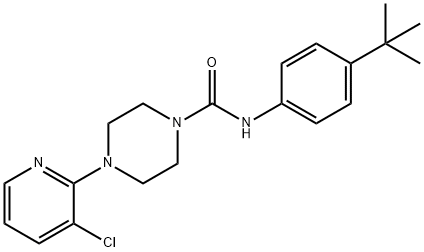
What is BCTC?
Description
BCTC (393514-24-4) is a vanilloid receptor I (TRPV1) blocker, IC50 = 35 nM for capsaicin-induced and 6 nM for acid-induced TRPV1 activation. Displays analgesic activity in rat models of neuropathic pain. BCTC is orally active and cell permeable.
The Uses of BCTC
BCTC is a antagonists of TRPA1 and TRPV1, a non-selective cation channel gated by noxious heat, vanilloids and extracellular protons. BCTC inhibits both capsaicin and proton activation.
What are the applications of Application
BCTC is an effective and potent TRPV1 channel antagonist
Definition
ChEBI: 1-piperazinecarboxamide, 4-(3-chloro-2-pyridinyl)-n-[4-(1,1-dimethylethyl)phenyl]- is a member of piperazines and a member of pyridines.
Storage
Room temperature
References
1) Valenzano et al. (2003), N-(4-tertiarybutylphenyl)-4-(3-chloropyridin-2-yl)tetrahydropyrazine -1(2H)-carbox-amide (BCTC), a novel, orally effective vanilloid receptor 1 antagonist with analgesic properties: I. in vitro characterization and pharmacokinetic properties; J. Pharmacol. Exp. Ther., 306 377 2) Pomonis et al. (2003), N-(4-Tertiarybutylphenyl)-4-(3-cholorphyridin-2-yl)tetrahydropyrazine -1(2H)-carbox-amide (BCTC), a novel, orally effective vanilloid receptor 1 antagonist with analgesic properties: II. in vivo characterization in rat models of inflammatory and neuropathic pain; J. Pharmacol. Exp. Ther., 306 387
Properties of BCTC
| Melting point: | 150-152℃ |
| Boiling point: | 561.6±50.0 °C(Predicted) |
| Density | 1.229±0.06 g/cm3(Predicted) |
| storage temp. | Sealed in dry,Room Temperature |
| solubility | DMSO: >10mg/mL |
| pka | 13.95±0.70(Predicted) |
| form | powder |
| color | white to beige |
| Sensitive | Light Sensitive |
| Stability: | Stable for 2 years from date of purchase as supplied. Solutions in DMSO or ethanol may be stord at -20°C for up to 2 months. |
Safety information for BCTC
| Signal word | Warning |
| Pictogram(s) |
 Exclamation Mark Irritant GHS07 |
| GHS Hazard Statements |
H302:Acute toxicity,oral |
| Precautionary Statement Codes |
P270:Do not eat, drink or smoke when using this product. P330:Rinse mouth. P301+P312:IF SWALLOWED: call a POISON CENTER or doctor/physician IF you feel unwell. P403:Store in a well-ventilated place. |
Computed Descriptors for BCTC
| InChIKey | ROGUAPYLUCHQGK-UHFFFAOYSA-N |
New Products
2-(2-Chlorophenyl)glycine Propiolic Acid 1-(3-Hydroxy-4-methoxyphenyl)-2-nitroethene (±)-amino(2-fluorophenyl)acetic acid trans-3-Benzyloxy-4-methoxy-beta-nitrostyrene 1-Pentadecanol 4-(4-Αminophenyl)-3-Morpholinone 3-Morpholino-1-(4-(2-oxopiperidin-1-yl) phenyl)-5,6-dihyropyridin-2-(1H)-one 1-(4-Aminophenyl)-3-morpholino-5,6-dihydropyridin-2(1H)-one N-cyanoacetylurethane 1H-IndazoleRelated products of tetrahydrofuran


You may like
-
 Bctc 95% CAS 393514-24-4View Details
393514-24-4 -
BCTC CAS 393514-24-4View Details
393514-24-4 -
471-25-0 Propiolic Acid 98+View Details
471-25-0 -
84145-28-8 98+View Details
84145-28-8 -
trans-3-Benzyloxy-4-methoxy-beta-nitrostyrene 98+View Details
63909-29-5 -
2-(2-Chlorophenyl)glycine 88744-36-9 98+View Details
88744-36-9 -
40216-83-9 trans-4-Hydroxy-L-proline methyl ester hydrochloride 98+View Details
40216-83-9 -
1-(3-Hydroxy-4-methoxyphenyl)-2-nitroethene 98+View Details
39816-35-8