
Asiatic acid
Synonym(s):2α,23-Dihydroxyursolic acid;Dammarolic acid;NSC 166063
- CAS NO.:464-92-6
- Empirical Formula: C30H48O5
- Molecular Weight: 488.7
- MDL number: MFCD00238541
- EINECS: 482-720-9
- SAFETY DATA SHEET (SDS)
- Update Date: 2026-07-27 17:00:41
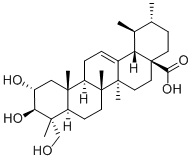
What is Asiatic acid?
The Uses of Asiatic acid
Asiatic Acid is a terpenoid with an ursane skeleton isolated from Centella asiatica. Asiatic Acid is a neuroprotectant and induces of apoptosis in HepG2 human hepatoma cells.
The Uses of Asiatic acid
wound healing, experimental carcinogen
The Uses of Asiatic acid
Asiatic acid is commonly used in wound healing. Asiatic acid has antioxidant, anti-inflammatory and neuroprotective properties. It is a starting material for asiatic acid derivative synthesis for use as anticancer agents, glycogen phosphorylase inhibitors and and hepatoprotectants.
Definition
ChEBI: A pentacyclic triterpenoid that is ursane substituted by a carboxy group at position 28 and hydroxy groups at positions 2, 3 and 23 (the 2alpha,3beta stereoisomer). It is isolated from Symplocos lancifolia and Vateria indica and exhibits anti-angiogenic activity.
What are the applications of Application
Asiatic acid is a pentacyclic triterpene that is known to stimulate wound healing by increasing collagen production
General Description
Asiatic acid is a naturally occurring pentacyclic triterpenoid, obtained from Centella asiatica.
Biochem/physiol Actions
Asiatic acid is commonly used in wound healing. Asiatic acid has antioxidant, anti-inflammatory and neuroprotective properties.
Properties of Asiatic acid
| Melting point: | 325-330 °C(lit.) |
| Boiling point: | 609.4±55.0 °C(Predicted) |
| Density | 1.18±0.1 g/cm3(Predicted) |
| RTECS | YU9580000 |
| storage temp. | 2-8°C |
| solubility | methanol: soluble1mg/mL, clear, colorless |
| form | powder |
| pka | 4.66±0.70(Predicted) |
| color | white |
| Water Solubility | Soluble in dimethyl sulfoxide, ethanol and dimethylformamide. Sparingly soluble in water |
| CAS DataBase Reference | 464-92-6(CAS DataBase Reference) |
Safety information for Asiatic acid
| Signal word | Warning |
| Pictogram(s) |
 Exclamation Mark Irritant GHS07 |
| GHS Hazard Statements |
H413:Hazardous to the aquatic environment, long-term hazard |
| Precautionary Statement Codes |
P273:Avoid release to the environment. |
Computed Descriptors for Asiatic acid
| InChIKey | JXSVIVRDWWRQRT-UYDOISQJSA-N |
Asiatic acid manufacturer
New Products
9-Mesityl-10-methylacridinium perchlorate Sulfapyridine Fmoc-OSu (R)-(-)-2-Amino-1-propanol Cyclobutanone 5-bromo-4-fluoro-2-nitrobenzaldehyde 4 pentyn 1 ol N-Vinylformamide Phenethyl cinnamate Pyrrolo[1,2-a]pyrimidine-6-carboxylic acid, 4,6,7,8-tetrahydro-4-oxo-, sodium salt (1:1), (6S) Ethyl 3-phenylpropanoate β-Bromostyrene Methacrylate-PEG-Methacrylate, Mn:35000 2,4-Dihydroxyacetophenone 2-Chloro 5-Fluoro Pyridine Vasicinone 2-Chloroisonicotinic Acid Tween 80 or Polysorbate 80 5-Bromo-1-Pentyne 1-(2-Methyl-5-nitrophenyl)guanidine Nitrate Methyl trans-4-Aminocyclohexanecarboxylate Hydrochloride 2-Pentyn-1-oL 4-Nitrobenzotrifluoride N-(4-Cyano-3-(trifluoromethyl)phenyl)-2-methyloxirane-2-carboxamideRelated products of tetrahydrofuran


You may like
-
 Asiatic Acid CAS 464-92-6View Details
464-92-6 -
Asiatic acid 98% (HPLC) CAS 464-92-6View Details
464-92-6 -
Asiatic acid CAS 464-92-6View Details
464-92-6 -
Asiatic acid CAS 464-92-6View Details
464-92-6 -
Asiatic acid CAS 464-92-6View Details
464-92-6 -
Asiatic acid CAS 464-92-6View Details
464-92-6 -
464-92-6 Asiatic acid >98%View Details
464-92-6 -
Fmoc-OSu 98+View Details
82911-69-1