
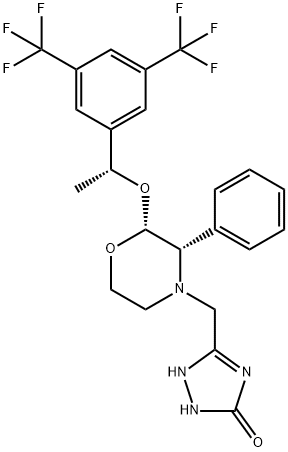
Aprepitant-d4
- CAS NO.:1133387-60-6
- Empirical Formula: C23H17D4F7N4O3
- Molecular Weight: 538.45
- MDL number: MFCD11977964
- SAFETY DATA SHEET (SDS)
- Update Date: 2026-07-24 20:02:52

What is Aprepitant-d4?
The Uses of Aprepitant-d4
Aprepitant-d4 is a labeled analogue of Aprepitant (A729800), A novel selective neurokinin-1 (NK-1) receptor antagonist. In vitro studies using human liver microsomes indicate that Aprepitant is metabolised primarily by CYP3A4 with minor metabolism by CYP1A2 and CYP2C19, and no metabolism by CYP2D6, CYP2C9, or CYP2E1. Aprepitant-d4 is a potential treatment for chemotherapy induced nausea and vomiting.
Properties of Aprepitant-d4
| Melting point: | 242-244°C |
| storage temp. | -20°C Freezer |
| solubility | DMSO (Slightly), Methanol (Slightly, Sonicated) |
| form | Solid |
| color | White to Off-White |
Safety information for Aprepitant-d4
Computed Descriptors for Aprepitant-d4
New Products
2-(2-Chlorophenyl)glycine Propiolic Acid 1-(3-Hydroxy-4-methoxyphenyl)-2-nitroethene (±)-amino(2-fluorophenyl)acetic acid trans-3-Benzyloxy-4-methoxy-beta-nitrostyrene 1-Pentadecanol 4-(4-Αminophenyl)-3-Morpholinone 3-Morpholino-1-(4-(2-oxopiperidin-1-yl) phenyl)-5,6-dihyropyridin-2-(1H)-one 1-(4-Aminophenyl)-3-morpholino-5,6-dihydropyridin-2(1H)-one N-cyanoacetylurethane 1H-IndazoleRelated products of tetrahydrofuran


You may like
-
 40216-83-9 trans-4-Hydroxy-L-proline methyl ester hydrochloride 98+View Details
40216-83-9 -
471-25-0 Propiolic Acid 98+View Details
471-25-0 -
84145-28-8 98+View Details
84145-28-8 -
trans-3-Benzyloxy-4-methoxy-beta-nitrostyrene 98+View Details
63909-29-5 -
2-(2-Chlorophenyl)glycine 88744-36-9 98+View Details
88744-36-9 -
40216-83-9 trans-4-Hydroxy-L-proline methyl ester hydrochloride 98+View Details
40216-83-9 -
629-76-5 98+View Details
629-76-5 -
1-(3-Hydroxy-4-methoxyphenyl)-2-nitroethene 98+View Details
39816-35-8
Statement: All products displayed on this website are only used for non medical purposes such as industrial applications or scientific research, and cannot be used for clinical diagnosis or treatment of humans or animals. They are not medicinal or edible.