
Amyl 4-Carboxyphenyl Carbonate
- CAS NO.:377085-56-8
- Empirical Formula: C13H16O5
- Molecular Weight: 252.26
- MDL number: MFCD00059647
- Update Date: 2023-07-12 17:03:57
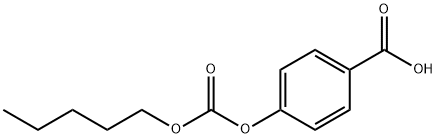
Properties of Amyl 4-Carboxyphenyl Carbonate
| Melting point: | 141 °C |
| Boiling point: | 394.7±34.0 °C(Predicted) |
| Density | 1.190±0.06 g/cm3(Predicted) |
| solubility | almost transparency in EtOH |
| pka | 4.04±0.10(Predicted) |
| form | powder to crystal |
| color | White to Almost white |
Safety information for Amyl 4-Carboxyphenyl Carbonate
Computed Descriptors for Amyl 4-Carboxyphenyl Carbonate
New Products
1,3-Dichloroacetone Ethylene Ketal 1-N-Boc-3-(aminoethyl)azetidine 4-N-BOC-AMINO-4-CARBOXYTETRAHYDROPYRAN AMino-(3-Methylphenyl)-acetic acid 3-AMINO-3-(2-CHLORO-PHENYL)-PROPIONIC ACID 4-Fluorophenylglycine 4, 4'-Ditolylamine (or) 4,4-Dimethyl Diphenylamine 2-Bromo-5-Chloropyridine 2-Picolinic acid N-oxide 4-Butyl Resorcinol 2-(2,4-Diaminophenoxy)ethanol Dihydrochloride 5-Bromo-2-Hydroxy-3-Nitro Pyridine 4-(4-(Dimethylamino)-1-(4-fluorophenyl)-1-hydroxybutyl)-3-(hydroxymethyl)benzonitrile Tetracaine Hydrochloride Ep Grade 2,2,2-Trichloroethyl chloroformate 5-Bromo-4-chloro-3-indolyl-β-D-galactopyranoside 4-Pentyn-1-ol 2-Bromo-6-fluoroaniline 5-fluoro-1,3-benzodioxole 5-Phenyl-[1,3,4]-thiadiazol-2-amine 2-Chloro-6-nitro benzothiazole 2-(Chloromethyl) quinazolin-4(3H)-one 2-Amino-4-phenyl-thiazole 4-Chloro-2-methyl quinolineYou may like
-
 Amyl 4-Carboxyphenyl Carbonate CAS 377085-56-8View Details
377085-56-8 -
944401-57-4 98+View Details
944401-57-4 -
68208-20-8 3-AMINO-3-(2-CHLORO-PHENYL)-PROPIONIC ACID 98+View Details
68208-20-8 -
7292-73-1 98+View Details
7292-73-1 -
68208-20-8 3-AMINO-3-(2-CHLORO-PHENYL)-PROPIONIC ACID 98+View Details
68208-20-8 -
7292-73-1 98+View Details
7292-73-1 -
68208-20-8 3-AMINO-3-(2-CHLORO-PHENYL)-PROPIONIC ACID 98+View Details
68208-20-8 -
7292-73-1 98+View Details
7292-73-1
Statement: All products displayed on this website are only used for non medical purposes such as industrial applications or scientific research, and cannot be used for clinical diagnosis or treatment of humans or animals. They are not medicinal or edible.