
Amsacrine
- CAS NO.:51264-14-3
- Empirical Formula: C21H19N3O3S
- Molecular Weight: 393.46
- MDL number: MFCD00242748
- EINECS: 257-094-3
- SAFETY DATA SHEET (SDS)
- Update Date: 2026-08-02 18:55:13
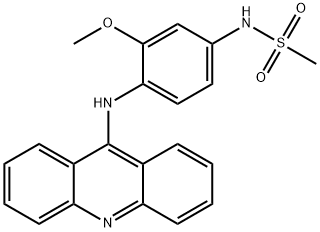
What is Amsacrine?
Absorption
Poorly absorbed
Toxicity
Symptoms of overdose include nausea and vomiting, diarrhea, some cardiotoxicity (rarely).
Description
Amsacrine is a cytostatic reported to be active against adult lymphoblastic leukemia which has failed primary treatment or become resistant. Its clinical use, however, is associated with significant neuro-, gastro- and hepatotoxicity.
Originator
Auckland Cancer Chemotherapy Lab (New Zealand)
The Uses of Amsacrine
Amsacrine (Amsidyl) is used as an Investigational drug.
The Uses of Amsacrine
Antineoplastic.
The Uses of Amsacrine
Amsacrine is a drug undergoing intensive trials for severe leukemia and lymphoma. It is a cytotoxic drug that binds with DNA with expressed specificity to the adenosine–tyrosine pair, thus inhibiting DNA synthesis. It has been suggested to be used for severe leukemia. A synonym of this drug is amsidyl.
Indications
For treatment of acute myeloid leukaemia.
Background
Aminoacridine derivative that is a potent intercalating antineoplastic agent. It is effective in the treatment of acute leukemias and malignant lymphomas, but has poor activity in the treatment of solid tumors. It is frequently used in combination with other antineoplastic agents in chemotherapy protocols. It produces consistent but acceptable myelosuppression and cardiotoxic effects.
Definition
ChEBI: A sulfonamide that is N-phenylmethanesulfonamide substituted by a methoxy group at position 3 and an acridin-9-ylamino group at position 4. It exhibits antineoplastic activity.
brand name
Amsidyl (Parke-Davis);Amsakrin.
Pharmacokinetics
Amsacrine is an aminoacridine derivative that is a potent intercalating antineoplastic agent. It is effective in the treatment of acute leukemias and malignant lymphomas, but has poor activity in the treatment of solid tumors. It is frequently used in combination with other antineoplastic agents in chemotherapy protocols. It produces consistent but acceptable myelosuppression and cardiotoxic effects.
Synthesis
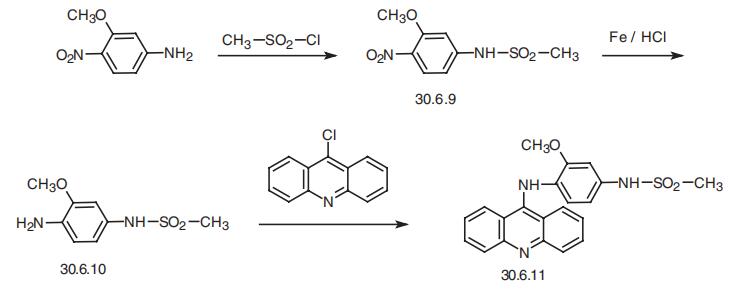
Amsacrine, 4-(9-acridinylamino)-3-methoxyphenyl-N-methansulfonamide (30.6.11), is made by sulfonating 4-nitro-m-anisidine with methanesulfonyl chloride, which forms a sulfonyl amide 30.6.9, and the nitro group is reduced to an amino group by hydrogen, forming 4-amino-3-methoxyphenyl-N-methansulfonamide (30.6.10). Reacting this with 9-chloroacridine gives amsacrine (30.6.11).
Metabolism
Extensive, primarily hepatic, converted to glutathione conjugate.
References
[1] nelson em, tewey km, liu lf. mechanism of antitumor drug action: poisoning of mammalian dna topoisomerase ii on dna by 4'-(9-acridinylamino)-methanesulfon-m-anisidide. proc natl acad sci u s a. 1984 mar;81(5):1361-5.
Properties of Amsacrine
| Melting point: | 230-240 °C |
| Boiling point: | 563.0±60.0 °C(Predicted) |
| Density | 1.2205 (rough estimate) |
| refractive index | 1.6740 (estimate) |
| storage temp. | 2-8°C(protect from light) |
| solubility | Soluble in DMSO |
| form | Powder |
| pka | 8.55±0.10(Predicted) |
| color | Orange to red |
| CAS DataBase Reference | 51264-14-3 |
| IARC | 2B (Vol. 76) 2000 |
Safety information for Amsacrine
| Signal word | Warning |
| Pictogram(s) |
 Exclamation Mark Irritant GHS07 |
| GHS Hazard Statements |
H227:Flammable liquids H315:Skin corrosion/irritation H319:Serious eye damage/eye irritation |
| Precautionary Statement Codes |
P210:Keep away from heat/sparks/open flames/hot surfaces. — No smoking. P264:Wash hands thoroughly after handling. P264:Wash skin thouroughly after handling. P280:Wear protective gloves/protective clothing/eye protection/face protection. P302+P352:IF ON SKIN: wash with plenty of soap and water. P305+P351+P338:IF IN EYES: Rinse cautiously with water for several minutes. Remove contact lenses, if present and easy to do. Continuerinsing. P332+P313:IF SKIN irritation occurs: Get medical advice/attention. P337+P313:IF eye irritation persists: Get medical advice/attention. P370+P378:In case of fire: Use … for extinction. P403+P235:Store in a well-ventilated place. Keep cool. |
Computed Descriptors for Amsacrine
Amsacrine manufacturer
New Products
2-Amino-5-bromo-4-(trifluoromethyl)pyridine Sulfapyridine Fmoc-OSu (R)-(-)-2-Amino-1-propanol Cyclobutanone 5-bromo-4-fluoro-2-nitrobenzaldehyde β-Bromostyrene Ethyl 3-phenylpropanoate Phenethyl cinnamate Dipropyl disulfide N-Vinylformamide 4 pentyn 1 ol Methacrylate-PEG-Methacrylate, Mn:35000 2,4-Dihydroxyacetophenone 2-Chloro 5-Fluoro Pyridine Vasicinone 2-Chloroisonicotinic Acid Tween 80 or Polysorbate 80 2-Butyn-1-oL 2-Pentyn-1-oL 4-Nitrobenzotrifluoride N-(4-fluoro-2-methoxy-5-nitrophenyl)-4-(1-methyl-1H-indol-3-yl)pyrimidin-2-amine Pirtobrutinib intd. N-(4-Cyano-3-(trifluoromethyl)phenyl)-2-methyloxirane-2-carboxamideRelated products of tetrahydrofuran
You may like
-
 Amsacrine 95.00% CAS 51264-14-3View Details
51264-14-3 -
Amsacrine 99% (HPLC) CAS 51264-14-3View Details
51264-14-3 -
Fmoc-OSu 98+View Details
82911-69-1 -
(R)-(-)-2-Amino-1-propanol 35320-23-1 98+View Details
35320-23-1 -
1191-95-3 Cyclobutanone 98+View Details
1191-95-3 -
213382-45-7 98+View Details
213382-45-7 -
Fmoc-OSu 98+View Details
82911-69-1 -
(R)-(-)-2-Amino-1-propanol 35320-23-1 98+View Details
35320-23-1