
ALANYCARB
- CAS NO.:83130-01-2
- Empirical Formula: C17H25N3O4S2
- Molecular Weight: 399.53
- MDL number: MFCD00274585
- SAFETY DATA SHEET (SDS)
- Update Date: 2026-05-28 06:32:10
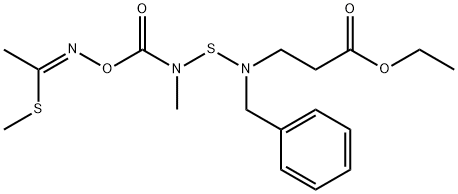
What is ALANYCARB?
The Uses of ALANYCARB
Alanycarb is a oxime carbamate inseciticide with acetylcholinesterase inhibitor activity.
The Uses of ALANYCARB
Alanycarb is a broad spectrum oxime carbamate insecticide with both contact and oral toxicity to a wide variety of insect pests, especially Lepidoptera, Coleoptera, Hemiptera and Thysanoptera, in/on grapes, pome fruits, tobacco and vegetables. Alanycarb can be applied as foliar, soil or seed treatments.
The Uses of ALANYCARB
Alanycarb may be used as an analytical reference standard for the determination of the analyte in:
- Olive oil samples by fast liquid chromatography-electrospray time-of-flight mass spectrometry (LC-TOFMS).
- Vegetables and fruit juices by LC coupled to tandem mass spectrometry (MS/MS).
Definition
ChEBI: Alanycarb is a carbamate ester and an ethyl ester. It has a role as a carbamate insecticide, an EC 3.1.1.7 (acetylcholinesterase) inhibitor, an agrochemical and a nematicide.
General Description
Alanycarb is classified under the oxime carbamate group of insecticides. Its mode of action involves the inhibition of cholinesterase enzyme.
Metabolic pathway
Alanycarb is a pro-insecticide which transforms either chemically or biologically into the active substance methomyl. Alanycarb metabolism in soil, plants and animals follows a common pathway that is consistent with methomyl. The primary metabolic pathway involves the initial cleavage of the N-S bond of alanycarb to yield methomyl and ethyl N-benzyl-β-alaninate. Methomyl is further metabolised to S-methyl-N-hydroxythioacetimidate and ultimately to acetonitrile, acetic acid and carbon dioxide (Scheme 1). See also the methomyl entry.
Degradation
Alanycarb (1) was stable to hydrolytic degradation in neutral and weakly
basic solutions (pH 7 and 9) at 30 °C with DT50 of 49 hours and 130 hours,
respectively. It degraded rapidly (DT50 0.5 hours) in acidic solution (pH 5)
at 20 °C (Yagi and Kawata, 1992). In acidic buffer solution (pH 4.0), the
major hydrolytic degradation product was methomyl (2). The disulfide
derivative (3) of alanycarb was observed as a minor product. In pH 7
and 9 solutions, hydrolysis of methomyl [S-methyl-N-hydroxythioacetimidate
(4)] occurred and polar unknown products were found as major
degradation products (Kawata, 1994).
Alanycarb degraded rapidly under xenon lamp irradiation (light
intensity: 280-300 μEm-2 s-1) in distilled water with a DT50 of 9.3 hours
(Yagi and Kawata, 1993).
Properties of ALANYCARB
| Melting point: | 47~52℃ |
| Boiling point: | 506.2±60.0 °C(Predicted) |
| Density | 1.18 |
| vapor pressure | ﹤4.7×10⁻⁶pa at 20°C |
| storage temp. | 2-8°C |
| solubility | Chloroform (Slightly), Methanol (Slightly) |
| pka | 0.37±0.70(Predicted) |
| form | neat |
| Water Solubility | 20 mg l-1 in water (20 °C) |
Safety information for ALANYCARB
| Signal word | Danger |
| Pictogram(s) |
 Skull and Crossbones Acute Toxicity GHS06  Environment GHS09 |
| GHS Hazard Statements |
H302:Acute toxicity,oral H330:Acute toxicity,inhalation H400:Hazardous to the aquatic environment, acute hazard |
| Precautionary Statement Codes |
P260:Do not breathe dust/fume/gas/mist/vapours/spray. P264:Wash hands thoroughly after handling. P264:Wash skin thouroughly after handling. P270:Do not eat, drink or smoke when using this product. P273:Avoid release to the environment. P301+P312:IF SWALLOWED: call a POISON CENTER or doctor/physician IF you feel unwell. |
Computed Descriptors for ALANYCARB
New Products
2-Bromo-4-hydroxypyridine Dibenzoyl-L-tartaric acid Anhydrous (Resolution Reagent) Dibenzo[b,f][1,4]thiazepin-11(10H)-one 1,2,3,9-Tetrahydro-9-Methyl-4H-Carbazole-4-One Cis-Tosylate 1-(4-methoxyphenyl)-4-(4-Nitrophenyl)Piperazine (IT-1) 2'-Fluoroacetophenone 1-aminocyclobutanecarbonitrile hydrochloride AMINO-O-TOLYL-ACETIC ACID N-Methyl-2-amino-2-methylpropionamide 4-(FMOC-AMINO)-TETRAHYDROPYRAN-4-CARBOXYLIC ACID 1-Aminocyclobutanecarboxylic Acid Hydrochloride METHANOL-D1(OD) TERTIARY BUTANOL-D9 N-ETHYL-D5-AMINE HYDROCHLORIDE BENZOIC ACID-D CHLOROFORM-D TOLUENE-D3 2-(2-Bromophenyl)ethanol Boc-D-Glu(OMe)-OMe 2,5 Dibromopyridine Ethyl 4-hydroxy-3-oxobutanoate Dimethyl (2S)-2-((tert-butoxycarbonyl)amino)-4-(cyanomethyl)pentanedioate 1-(3-Chlorophenyl)piperazine hydrochlorideRelated products of tetrahydrofuran
You may like
-
 Alanycarb CAS 83130-01-2View Details
83130-01-2 -
98071-16-0 1-Aminocyclobutanecarboxylic Acid Hydrochloride 98+View Details
98071-16-0 -
106914-07-2 N-Methyl-2-amino-2-methylpropionamide 98+View Details
106914-07-2 -
129592-98-9 98+View Details
129592-98-9 -
4-(FMOC-AMINO)-TETRAHYDROPYRAN-4-CARBOXYLIC ACID 98+View Details
285996-72-7 -
1-aminocyclobutanecarbonitrile hydrochloride 845821-84-3 98+View Details
845821-84-3 -
98071-16-0 1-Aminocyclobutanecarboxylic Acid Hydrochloride 98+View Details
98071-16-0 -
 ADC-151View Details
27176-87-0