
ACETYLCHOLINE BROMIDE
Synonym(s):ACh
- CAS NO.:66-23-9
- Empirical Formula: C7H16BrNO2
- Molecular Weight: 226.11
- MDL number: MFCD00011814
- EINECS: 200-622-4
- SAFETY DATA SHEET (SDS)
- Update Date: 2026-07-16 07:06:08
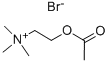
What is ACETYLCHOLINE BROMIDE?
Chemical properties
WHITE TO LIGHT BEIGE ADHERING CRYSTALLINE SOLID
The Uses of ACETYLCHOLINE BROMIDE
Acetylcholine is an endogenous neurotransmitter at cholinergic synapses that amplifies action potential of the sarcolemma thereby inducing muscle contractions. Acetylcholine bromide is used as an acetylcholine receptor agonist to identify, characterize and differentiate among types of cholinergic receptors. Acetylcholine bromide is used as an inhibitor to identify and characterize natural and mutated butyrylcholinesterase(s).
What are the applications of Application
Acetylcholine bromide is an endogenous neurotransmitter at cholinergic synapses
Definition
ChEBI: The bromide salt of acetylcholine.
Biochem/physiol Actions
Endogenous neurotransmitter at cholinergic synapses; amplifies action potential of the sarcolemma thereby inducing muscle contractions.
Purification Methods
The bromide is a hygroscopic solid, but less so than the hydrochloride salt. It crystallises from EtOH as prisms. Some hydrolysis occurs in boiling EtOH, particularly if it contains some H2O. It can also be recrystallised from EtOH or MeOH by adding dry Et2O. [Heilbronn Acta Chem Scand 12 1492 1958, Beilstein 4 IV 1446.]
Properties of ACETYLCHOLINE BROMIDE
| Melting point: | 140-143 °C(lit.) |
| Density | 1.4246 (rough estimate) |
| refractive index | 1.6120 (estimate) |
| storage temp. | -20°C |
| solubility | Methanol (Slightly), Water (Slightly) |
| form | Solid |
| color | Off-White |
| Water Solubility | almost transparency |
| Sensitive | Hygroscopic |
| Merck | 14,86 |
| BRN | 3572117 |
| CAS DataBase Reference | 66-23-9(CAS DataBase Reference) |
| EPA Substance Registry System | Acetylcholine bromide (66-23-9) |
Safety information for ACETYLCHOLINE BROMIDE
| Signal word | Warning |
| Pictogram(s) |
 Exclamation Mark Irritant GHS07 |
| GHS Hazard Statements |
H315:Skin corrosion/irritation H319:Serious eye damage/eye irritation |
| Precautionary Statement Codes |
P264:Wash hands thoroughly after handling. P264:Wash skin thouroughly after handling. P280:Wear protective gloves/protective clothing/eye protection/face protection. |
Computed Descriptors for ACETYLCHOLINE BROMIDE
New Products
9-Mesityl-10-methylacridinium perchlorate Sulfapyridine Fmoc-OSu (R)-(-)-2-Amino-1-propanol Cyclobutanone 5-bromo-4-fluoro-2-nitrobenzaldehyde 4 pentyn 1 ol N-Vinylformamide Phenethyl cinnamate Pyrrolo[1,2-a]pyrimidine-6-carboxylic acid, 4,6,7,8-tetrahydro-4-oxo-, sodium salt (1:1), (6S) Ethyl 3-phenylpropanoate β-Bromostyrene Methacrylate-PEG-Methacrylate, Mn:35000 2,4-Dihydroxyacetophenone 2-Chloro 5-Fluoro Pyridine Vasicinone 2-Chloroisonicotinic Acid Tween 80 or Polysorbate 80 5-Bromo-1-Pentyne 1-(2-Methyl-5-nitrophenyl)guanidine Nitrate Methyl trans-4-Aminocyclohexanecarboxylate Hydrochloride 2-Pentyn-1-oL 4-Nitrobenzotrifluoride N-(4-Cyano-3-(trifluoromethyl)phenyl)-2-methyloxirane-2-carboxamideRelated products of tetrahydrofuran




You may like
-
 Acetylcholine Bromide CAS 66-23-9View Details
66-23-9 -
Acetylcholine bromide, 99% CAS 66-23-9View Details
66-23-9 -
Acetylcholine Bromide CAS 66-23-9View Details
66-23-9 -
Acetylcholine bromide CAS 66-23-9View Details
66-23-9 -
1191-95-3 Cyclobutanone 98+View Details
1191-95-3 -
213382-45-7 98+View Details
213382-45-7 -
Fmoc-OSu 98+View Details
82911-69-1 -
(R)-(-)-2-Amino-1-propanol 35320-23-1 98+View Details
35320-23-1