
6,10-Dimethyl-5,9-undecadien-2-one
Synonym(s):6,10-Dimethyl-5,9-undecadien-2-one, mixture of isomers;Geranylacetone
- CAS NO.:689-67-8
- Empirical Formula: C13H22O
- Molecular Weight: 194.31
- MDL number: MFCD00008910
- EINECS: 211-711-2
- SAFETY DATA SHEET (SDS)
- Update Date: 2026-06-16 21:18:09
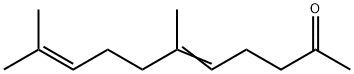
What is 6,10-Dimethyl-5,9-undecadien-2-one?
Description
Why do fresh home-grown tomatoes taste so much better than store-bought ones? The answer lies in a genetic modification that was introduced into commercial tomatoes to give them a longer shelf life. The downside of this mutation is that it reduces flavor and sugar development in the fruit.
Researchers in several nations led by Harry Klee at the University of Florida (Gainesville) and Sanwen Huang at the Chinese Academy of Agricultural Sciences (Beijing) determined how to modify mass-produced tomatoes?to restore desirable flavor components. The research team’s goal was to tell breeders which biochemicals are lacking in their tomatoes and to show them the markers they need to breed back in.
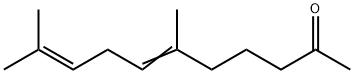
Based on the results of a human taste panel study, they identified 13 flavor molecules that are deficient in supermarket tomatoes. Two of the desired flavoring agents, geranylacetone?(upper images) and β-ionone (lower images), contribute “leafy” and “floral” flavors, respectively. The researchers then identified the regions of the tomato genome that are responsible for producing the 13 components.
Commenting on this study, James Giovannoni at the US Department of Agriculture said, “I don’t know if it’s possible to make a supermarket tomato that tastes exactly like it was grown in your own garden, but I have no doubt that this work can help breeders make supermarket tomatoes a lot better than they are now.”
Chemical properties
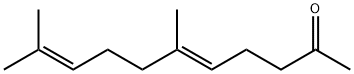
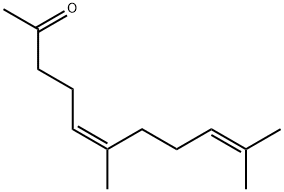
Geranylacetone occurs in (5Z)-trans
as well as in (5E)-trans form and has been identified in fruits and in essential oils.
It is a colorless liquid with a fresh, green, slightly penetrating, rose-like odor.
Geranylacetone is an intermediate in the synthesis of other fragrance substances.
It is mainly produced from linalool. Another route starts from myrcene,
to which methyl acetoacetate is added under rhodium catalysis; geranylacetone is
subsequently obtained after saponification and decarboxylation. It is used
in perfumery in rose compositions, for example, in soap perfumes.
Chemical properties
6,10-Dimethyl-5,9-undecadien-2-one has a green and rosy floral odor and fresh-floral, light, but rather penetrating sweet-rosy, slightly green, magnolia-like odor. It blends well in lavender and fruity notes, where it imparts a clean and natural character. It helps to round out floral bouquets
Occurrence
Reported found in oil of citronella, yellow passion fruit, peppermint, Scotch spearmint oil, Japanese seafood, scallop, tomato, tomato paste, citrus peel oils, carrots, papaya, melon, Parmesan cheese, milk powder, cognac, tea, starfruit, figs, mango, red sage, nectarines, clams, pork, anise, and hyssop
The Uses of 6,10-Dimethyl-5,9-undecadien-2-one
It is used as a flavoring agent and adjuvant. It is also employed as a substance, extract, or preparation for diffusing or imparting an agreeable or attractive smell.
Preparation
By reaction of linalool and ethyl acetoacetate with an alkaline catalyst and subsequent rearrangement and decarboxylation.
What are the applications of Application
Geranylacetone is an intermediate in nerolidol synthesis. It is used in perfumery in rose compositions, for example, in soap perfumes.
Definition
ChEBI: Geranyl acetone is a monoterpene ketone in which an (E)-geranyl group is bonded to one of the alpha-methyls of acetone. It is a component of essential oils from various plants including Nelumbo nucifera. It has a role as a flavouring agent, a fragrance, a volatile oil component and a plant metabolite. It contains a geranyl group.
Aroma threshold values
Detection: 60 ppb to 6.4 ppm
Taste threshold values
Taste characteristics at 12 ppm: floral, fruity, fatty, green, pear, apple and banana nuances
General Description
6,10-Dimethyl-5,9-undecadien-2-one is one of the key volatile flavor compounds of tomato and certain species of mushroom.
Safety Profile
A skin irritant. When heated to decomposition it emits acrid smoke and irritating fumes.
Properties of 6,10-Dimethyl-5,9-undecadien-2-one
| Boiling point: | 254-258 °C(lit.) |
| Density | 0.873 g/mL at 25 °C(lit.) |
| refractive index | n |
| FEMA | 3542 | 6,10-DIMETHYL-5,9-UNDECADIEN-2-ONE |
| Flash point: | >230 °F |
| storage temp. | Amber Vial, Refrigerator, Under inert atmosphere |
| solubility | Chloroform, Dichloromethane (Slightly) |
| form | Oil |
| color | Colourless |
| Odor | at 100.00 %. fresh rose leaf floral green magnolia aldehydic fruity |
| Water Solubility | Not miscible or difficult to mix in water. Soluble in alcohol. |
| JECFA Number | 1122 |
| BRN | 1722277 |
| Stability: | Light Sensitive |
| CAS DataBase Reference | 689-67-8(CAS DataBase Reference) |
| NIST Chemistry Reference | 5,9-Undecadien-2-one, 6,10-dimethyl-(689-67-8) |
| EPA Substance Registry System | 5,9-Undecadien-2-one, 6,10-dimethyl- (689-67-8) |
Safety information for 6,10-Dimethyl-5,9-undecadien-2-one
| Signal word | Warning |
| Pictogram(s) |
 Exclamation Mark Irritant GHS07  Environment GHS09 |
| GHS Hazard Statements |
H315:Skin corrosion/irritation H411:Hazardous to the aquatic environment, long-term hazard |
| Precautionary Statement Codes |
P264:Wash hands thoroughly after handling. P264:Wash skin thouroughly after handling. P273:Avoid release to the environment. P280:Wear protective gloves/protective clothing/eye protection/face protection. P302+P352:IF ON SKIN: wash with plenty of soap and water. P332+P313:IF SKIN irritation occurs: Get medical advice/attention. |
Computed Descriptors for 6,10-Dimethyl-5,9-undecadien-2-one
New Products
2-Amino-5-bromo-4-(trifluoromethyl)pyridine Sulfapyridine Fmoc-OSu (R)-(-)-2-Amino-1-propanol Cyclobutanone 5-bromo-4-fluoro-2-nitrobenzaldehyde β-Bromostyrene Ethyl 3-phenylpropanoate Phenethyl cinnamate Dipropyl disulfide N-Vinylformamide 4 pentyn 1 ol Methacrylate-PEG-Methacrylate, Mn:35000 2,4-Dihydroxyacetophenone 2-Chloro 5-Fluoro Pyridine Vasicinone 2-Chloroisonicotinic Acid Tween 80 or Polysorbate 80 2-Butyn-1-oL 2-Pentyn-1-oL 4-Nitrobenzotrifluoride N-(4-fluoro-2-methoxy-5-nitrophenyl)-4-(1-methyl-1H-indol-3-yl)pyrimidin-2-amine Pirtobrutinib intd. N-(4-Cyano-3-(trifluoromethyl)phenyl)-2-methyloxirane-2-carboxamideRelated products of tetrahydrofuran

You may like
-
 689-67-8 GERANYL ACETONE 98%View Details
689-67-8 -
![Geranylacetone [mixture of (E)- and (Z)- isomers, (3:2)] CAS 689-67-8](https://img.chemicalbook.in//Content/image/CP5.jpg) Geranylacetone [mixture of (E)- and (Z)- isomers, (3:2)] CAS 689-67-8View Details
Geranylacetone [mixture of (E)- and (Z)- isomers, (3:2)] CAS 689-67-8View Details
689-67-8 -
Fmoc-OSu 98+View Details
82911-69-1 -
(R)-(-)-2-Amino-1-propanol 35320-23-1 98+View Details
35320-23-1 -
1191-95-3 Cyclobutanone 98+View Details
1191-95-3 -
213382-45-7 98+View Details
213382-45-7 -
Fmoc-OSu 98+View Details
82911-69-1 -
(R)-(-)-2-Amino-1-propanol 35320-23-1 98+View Details
35320-23-1