
4,4',4''-Trimethyltriphenylamine
Synonym(s):N ,N ,N -Tri(4-methylphenyl)amine;Tri(4-methylphenyl)amine;Tri-4-tolylamine;Tritolylamine
- CAS NO.:1159-53-1
- Empirical Formula: C21H21N
- Molecular Weight: 287.4
- MDL number: MFCD00674043
- EINECS: 214-595-1
- SAFETY DATA SHEET (SDS)
- Update Date: 2026-05-28 05:13:22
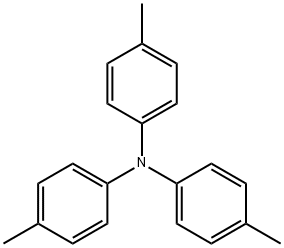
What is 4,4',4''-Trimethyltriphenylamine?
Chemical properties
White to light yellow to brown solid
The Uses of 4,4',4''-Trimethyltriphenylamine
Used for proteomics research. Also employed as a intermediate for pharmaceutical.
What are the applications of Application
Tri-p-tolylamine is Tri-p-tolylamine is a nitrogen compound for proteomics research.
Properties of 4,4',4''-Trimethyltriphenylamine
| Melting point: | 114-118°C |
| Boiling point: | 170 °C / 0.1mmHg |
| Density | 1.10 g/cm3 |
| storage temp. | Sealed in dry,2-8°C |
| solubility | Soluble in chloroform and tetrahydrofuran (THF). |
| form | Solid |
| pka | -1.76±0.50(Predicted) |
| color | White to off-white |
| CAS DataBase Reference | 1159-53-1(CAS DataBase Reference) |
| EPA Substance Registry System | Benzenamine, 4-methyl-N,N-bis(4-methylphenyl)- (1159-53-1) |
Safety information for 4,4',4''-Trimethyltriphenylamine
| Signal word | Warning |
| Pictogram(s) |
 Exclamation Mark Irritant GHS07 |
| GHS Hazard Statements |
H315:Skin corrosion/irritation H319:Serious eye damage/eye irritation H335:Specific target organ toxicity, single exposure;Respiratory tract irritation |
| Precautionary Statement Codes |
P233:Keep container tightly closed. P260:Do not breathe dust/fume/gas/mist/vapours/spray. P261:Avoid breathing dust/fume/gas/mist/vapours/spray. P264:Wash hands thoroughly after handling. P264:Wash skin thouroughly after handling. P271:Use only outdoors or in a well-ventilated area. P280:Wear protective gloves/protective clothing/eye protection/face protection. P304:IF INHALED: P312:Call a POISON CENTER or doctor/physician if you feel unwell. P321:Specific treatment (see … on this label). P340:Remove victim to fresh air and keep at rest in a position comfortable for breathing. P362:Take off contaminated clothing and wash before reuse. P302+P352:IF ON SKIN: wash with plenty of soap and water. P304+P340:IF INHALED: Remove victim to fresh air and Keep at rest in a position comfortable for breathing. P305+P351+P338:IF IN EYES: Rinse cautiously with water for several minutes. Remove contact lenses, if present and easy to do. Continuerinsing. P332+P313:IF SKIN irritation occurs: Get medical advice/attention. P337+P313:IF eye irritation persists: Get medical advice/attention. P403:Store in a well-ventilated place. P405:Store locked up. P403+P233:Store in a well-ventilated place. Keep container tightly closed. P501:Dispose of contents/container to..… |
Computed Descriptors for 4,4',4''-Trimethyltriphenylamine
New Products
2-(2-Chlorophenyl)glycine Propiolic Acid trans-3-Benzyloxy-4-methoxy-beta-nitrostyrene 1-(3-Hydroxy-4-methoxyphenyl)-2-nitroethene (±)-amino(2-fluorophenyl)acetic acid 1-Pentadecanol N-cyanoacetylurethane 4-(4-Αminophenyl)-3-Morpholinone 3-Morpholino-1-(4-(2-oxopiperidin-1-yl) phenyl)-5,6-dihyropyridin-2-(1H)-one 1-(4-Aminophenyl)-3-morpholino-5,6-dihydropyridin-2(1H)-one 1H-IndazoleRelated products of tetrahydrofuran
You may like
-
 Tri-p-tolylamine CAS 1159-53-1View Details
1159-53-1 -
471-25-0 Propiolic Acid 98+View Details
471-25-0 -
84145-28-8 98+View Details
84145-28-8 -
trans-3-Benzyloxy-4-methoxy-beta-nitrostyrene 98+View Details
63909-29-5 -
2-(2-Chlorophenyl)glycine 88744-36-9 98+View Details
88744-36-9 -
40216-83-9 trans-4-Hydroxy-L-proline methyl ester hydrochloride 98+View Details
40216-83-9 -
629-76-5 98+View Details
629-76-5 -
1-(3-Hydroxy-4-methoxyphenyl)-2-nitroethene 98+View Details
39816-35-8
Statement: All products displayed on this website are only used for non medical purposes such as industrial applications or scientific research, and cannot be used for clinical diagnosis or treatment of humans or animals. They are not medicinal or edible.