
4-Trifluoromethoxyphenylboronic acid
Synonym(s):4-(Trifluoromethoxy)benzeneboronic acid
- CAS NO.:139301-27-2
- Empirical Formula: C7H6BF3O3
- Molecular Weight: 205.93
- MDL number: MFCD01074648
- EINECS: 000-000-0
- SAFETY DATA SHEET (SDS)
- Update Date: 2026-05-28 05:41:15
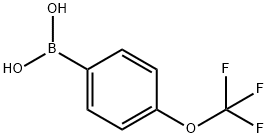
What is 4-Trifluoromethoxyphenylboronic acid?
Chemical properties
white to beige crystalline powder
The Uses of 4-Trifluoromethoxyphenylboronic acid
B-[4-(Trifluoromethoxy)phenyl]boronic Acid is a reagent used in the synthesis of orally bioavailable matrix metalloprotinase inhibitors. Also used in the preparation of chromen-4-one inhibitors used against DNA dependant protein kinases.
What are the applications of Application
4-Trifluoromethoxyphenylboronic acid can reactant involved in the synthesis of biologically active molecules including:
Lactate dehydrogenase inhibitors for use against cancer cell proliferation
Nitro-phenoxybenzoic acid derivatives for PAI-1 inhibition
PA-824 analogs for use as antituberculosis drugs
Modulators of survival motor neuron protein
Reactant involved in addition reactions and cross-coupling reactions including Suzuki-Miyaura cross-coupling
Properties of 4-Trifluoromethoxyphenylboronic acid
| Melting point: | 123-127 °C(lit.) |
| Boiling point: | 256.6±50.0 °C(Predicted) |
| Density | 1.41±0.1 g/cm3(Predicted) |
| storage temp. | Keep in dark place,Sealed in dry,Room Temperature |
| solubility | soluble in Methanol |
| form | Crystalline Powder |
| pka | 8.29±0.10(Predicted) |
| color | White to beige |
| BRN | 8548201 |
| CAS DataBase Reference | 139301-27-2(CAS DataBase Reference) |
Safety information for 4-Trifluoromethoxyphenylboronic acid
| Signal word | Warning |
| Pictogram(s) |
 Exclamation Mark Irritant GHS07 |
| GHS Hazard Statements |
H315:Skin corrosion/irritation H319:Serious eye damage/eye irritation H335:Specific target organ toxicity, single exposure;Respiratory tract irritation |
| Precautionary Statement Codes |
P261:Avoid breathing dust/fume/gas/mist/vapours/spray. P304+P340:IF INHALED: Remove victim to fresh air and Keep at rest in a position comfortable for breathing. P305+P351+P338:IF IN EYES: Rinse cautiously with water for several minutes. Remove contact lenses, if present and easy to do. Continuerinsing. P405:Store locked up. |
Computed Descriptors for 4-Trifluoromethoxyphenylboronic acid
| InChIKey | HUOFUOCSQCYFPW-UHFFFAOYSA-N |
New Products
Dibenzoyl-L-tartaric acid Anhydrous (Resolution Reagent) Cis-Tosylate Dibenzo[b,f][1,4]thiazepin-11(10H)-one 1,2,3,9-Tetrahydro-9-Methyl-4H-Carbazole-4-One 1-(4-methoxyphenyl)-4-(4-Nitrophenyl)Piperazine (IT-1) BOC Piperazine 1-Benzhydrylazetane-3-carbonitrile 8-oxa-1,3-diazaspiro[4.5]decane-2,4-dione (±)-amino(2-fluorophenyl)acetic acid 2-(2-Chlorophenyl)glycine AMINO-(3-CHLORO-PHENYL)-ACETIC ACID 2'-Fluoroacetophenone METHANOL-D1(OD) TERTIARY BUTANOL-D9 N-ETHYL-D5-AMINE HYDROCHLORIDE BENZOIC ACID-D CHLOROFORM-D TOLUENE-D3 Trans,trans muconic acid HC Blue-16 4-Amino-2-chloro-6,7-dimethoxyquinazoline Ethyl 4,5-bis(2-methoxyethoxy)-2-nitrobenzoate 2,3-Dimethoxypyridine 1-(3-Chlorophenyl)piperazine hydrochlorideRelated products of tetrahydrofuran

You may like
-
 4-(Trifluoromethoxy)phenylboronic Acid (contains varying amounts of Anhydride) CAS 139301-27-2View Details
139301-27-2 -
4-(Trifluoromethoxy)phenylboronic acid, 95% CAS 139301-27-2View Details
139301-27-2 -
 Product IntroductionView Details
 -
 Product InrtroductionView Details
 -
 DGO24View Details
 -
 DGO25View Details
 -
 DGO29View Details
 -
 DGO32View Details
Statement: All products displayed on this website are only used for non medical purposes such as industrial applications or scientific research, and cannot be used for clinical diagnosis or treatment of humans or animals. They are not medicinal or edible.