
4-Methyl-2-pentanone
Synonym(s):MIBK;Methyl isobutyl ketone;4-Methyl-2-pentanone;MIK;Isobutyl methyl ketone
- CAS NO.:108-10-1
- Empirical Formula: C6H12O
- Molecular Weight: 100.16
- MDL number: MFCD00008938
- EINECS: 203-550-1
- SAFETY DATA SHEET (SDS)
- Update Date: 2026-06-24 18:39:39
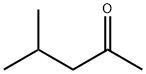
What is 4-Methyl-2-pentanone?
Description
4-Methyl-2-pentanone possesses a pleasant odor and can be prepared by the hydrogenation of mesityl oxide over a nickel catalyst at 160–190?°C, or alternatively by the oxidation of methyl isobutyl carbinol.
Chemical properties
4-Methyl-2-pentanone, commonly referred to as Methyl Isobutyl Ketone (MIBK), is a colorless liquid with a pleasant, sweet, fruity odor, possessing an odor threshold as low as 0.10 ppm. It exhibits a water solubility of 2% by weight and is miscible with various organic solvents. Its lower explosive limit is 1.2%, and the upper explosive limit reaches 8.0% at 200°F. MIBK may be incompatible with strong oxidizers and potassium tert-butoxide.
Occurrence
This compound is found in a wide range of natural products and foods, including fruit juices (orange, lemon, grape), vinegar, baked goods (wheat bread), dairy products (cheese, milk), meats (roast chicken, cooked beef, lamb fat, pork liver), seafood (crab, clam), alcoholic beverages (beer, brandy, plum brandy), drinks (coffee, tea), fruits and vegetables (papaya, ginger, baked potato, plum, mushroom, sesame, buckwheat), spices (hop oil, vanilla, sage), and fermented products (trassi, wort).
The Uses of 4-Methyl-2-pentanone
Methyl isobutyl ketone (MIBK, also known as 4-methyl-2-pentanone) is an organic solvent structurally and functionally similar to methyl butyl ketone. It is used not only as a solvent in paints, lacquers, and varnishes, but also in extraction processes and as a denaturant for rubbing alcohol. Additionally, it serves as a synthetic flavoring agent in certain rums, candies, and cheeses. Unlike methyl butyl ketone, MIBK does not occur naturally.
Production Methods
Methyl isobutyl ketone (MIBK) is primarily manufactured through two processes: the first is a mixed ketone method using isopropanol as a starting material to co-produce MIBK, diisobutyl ketone, and acetone in a single reaction; the second and dominant method involves a three-step reaction sequence generating diacetone alcohol and mesityl oxide as key intermediates en route to MIBK.
Reactivity Profile
4-Methyl-2-pentanone is incompatible with strong alkalis (e.g., caustic soda), strong inorganic acids (such as hydrochloric acid and sulfuric acid), amines, and oxidizing agents including hydrogen peroxide, nitric acid, perchloric acid, and chromium trioxide. It reacts violently with potassium tert-butoxide and vigorously with reducing materials.
Properties of 4-Methyl-2-pentanone
| Melting point: | -80 °C (lit.) |
| Boiling point: | 117-118 °C |
| Density | 0.801 g/mL at 25 °C (lit.) |
| vapor density | 3.5 (vs air) |
| vapor pressure | 15 mm Hg ( 20 °C) |
| refractive index | n |
| FEMA | 2731 | 4-METHYL-2-PENTANONE |
| Flash point: | 56 °F |
| storage temp. | Store at +5°C to +30°C. |
| solubility | water: soluble20g/L |
| form | Liquid |
| color | APHA: ≤15 |
| Specific Gravity | 0.80 |
| Odor | Pleasant; mild, characteristic; sharp; non-residual; ketonic. |
| explosive limit | 1.2-8%, 93°F |
| Odor Threshold | 0.17ppm |
| Water Solubility | 17 g/L (20 ºC) |
| λmax | λ: 335 nm Amax: 1.00 λ: 340 nm Amax: 0.50 λ: 360 nm Amax: 0.15 λ: 380 nm Amax: 0.02 λ: 400 nm Amax: 0.01 |
| JECFA Number | 301 |
| Merck | 14,5207 |
| BRN | 605399 |
| Henry's Law Constant | 2.56 at 25 °C (batch stripping method-GC, Kim et al., 2000) |
| Exposure limits | TLV-TWA 205 mg/m3 (50 ppm); STEL 300
mg/m3 (75 ppm) (ACGIH); IDLH 3000 ppm
(NIOSH). |
| Dielectric constant | 13.0(Ambient) |
| Stability: | Volatile |
| CAS DataBase Reference | 108-10-1(CAS DataBase Reference) |
| IARC | 2B (Vol. 101) 2013 |
| NIST Chemistry Reference | Methyl isobutyl ketone(108-10-1) |
| EPA Substance Registry System | Methyl isobutyl ketone (108-10-1) |
Safety information for 4-Methyl-2-pentanone
| Signal word | Danger |
| Pictogram(s) |
 Flame Flammables GHS02  Exclamation Mark Irritant GHS07 |
| GHS Hazard Statements |
H225:Flammable liquids H319:Serious eye damage/eye irritation H332:Acute toxicity,inhalation H335:Specific target organ toxicity, single exposure;Respiratory tract irritation |
| Precautionary Statement Codes |
P210:Keep away from heat/sparks/open flames/hot surfaces. — No smoking. P233:Keep container tightly closed. P240:Ground/bond container and receiving equipment. P241:Use explosion-proof electrical/ventilating/lighting/…/equipment. P305+P351+P338:IF IN EYES: Rinse cautiously with water for several minutes. Remove contact lenses, if present and easy to do. Continuerinsing. |
Computed Descriptors for 4-Methyl-2-pentanone
4-Methyl-2-pentanone manufacturer
New Products
2-Bromo-4-hydroxypyridine Dibenzoyl-L-tartaric acid Anhydrous (Resolution Reagent) Dibenzo[b,f][1,4]thiazepin-11(10H)-one 1,2,3,9-Tetrahydro-9-Methyl-4H-Carbazole-4-One Cis-Tosylate 1-(4-methoxyphenyl)-4-(4-Nitrophenyl)Piperazine (IT-1) 2'-Fluoroacetophenone 1-aminocyclobutanecarbonitrile hydrochloride AMINO-O-TOLYL-ACETIC ACID N-Methyl-2-amino-2-methylpropionamide 4-(FMOC-AMINO)-TETRAHYDROPYRAN-4-CARBOXYLIC ACID 1-Aminocyclobutanecarboxylic Acid Hydrochloride METHANOL-D1(OD) TERTIARY BUTANOL-D9 N-ETHYL-D5-AMINE HYDROCHLORIDE BENZOIC ACID-D CHLOROFORM-D TOLUENE-D3 2-(2-Bromophenyl)ethanol Boc-D-Glu(OMe)-OMe 2,5 Dibromopyridine Ethyl 4-hydroxy-3-oxobutanoate Dimethyl (2S)-2-((tert-butoxycarbonyl)amino)-4-(cyanomethyl)pentanedioate 1-(3-Chlorophenyl)piperazine hydrochlorideRelated products of tetrahydrofuran

You may like
-
 Methyl Iso Butyl Ketone 98%View Details
 -
 4-Methyl-2-pentanone CAS 108-10-1View Details
108-10-1 -
4-Methyl-2-pentanone CAS 108-10-1View Details
108-10-1 -
4-Methyl-2-pentanone, Filtered through 0.2μ filters. CAS 108-10-1View Details
108-10-1 -
4-Methyl-2-pentanone, Filtered through 0.2μ filters. CAS 108-10-1View Details
108-10-1 -
Methyl Isobutyl Ketone CASView Details
-
Methyl Isobutyl Ketone CASView Details
-
 Methyl Isobutyl Ketone, >99%, 200 Litre Drum, for Printing InkView Details
108-10-1