
3,6-Dimethyl-1,4-dioxane-2,5-dione homopolymer
Synonym(s):Lactide polymer;PDLLA;Polylactide;Resomer R 205 S, PDLLA;Resomer R 207 S, PDLLA
- CAS NO.:26680-10-4
- Empirical Formula: (C6H8O4)x
- Molecular Weight: 144.13
- MDL number: MFCD00217751
- Update Date: 2026-01-13 11:18:01
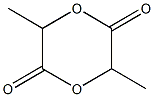
What is 3,6-Dimethyl-1,4-dioxane-2,5-dione homopolymer?
Chemical properties
Poly(DL-lactic acid) is a glassy material, occurring as white to golden-yellow pellets or granules.
The Uses of 3,6-Dimethyl-1,4-dioxane-2,5-dione homopolymer
Controlled release
The Uses of 3,6-Dimethyl-1,4-dioxane-2,5-dione homopolymer
May be used to make drug delivery materials for controlled release.
Definition
ChEBI: Lactide is a member of dioxanes.
Production Methods
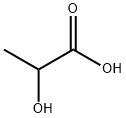
Lactic acid is a chiral molecule and has two optically active forms: Llactic acid and D-lactic acid. Poly(DL-lactic acid) is produced from the racemic mixture of lactic acid. Lactic acid is produced either from ethylene (petrochemical pathway) or by bacterial fermentation of D-glucose derived from food stocks. The former pathway involves an oxidation step followed by treatment with hydrogen cyanide and produces only racemic DL-lactic acid. In contrast, lactic acid produced by fermentation occurs mainly as L-lactic acid. Lowmolecular- weight poly-DL-(lactic acid) (500–10 000 Da) is produced directly from lactic acid by condensation. Higher-molecular-weight product is produced by one of two major pathways. The first involves a depolymerization of low-molecular-weight polymer into the cyclic dimer form (lactide) followed by ring-opening polymerization. Alternatively, it can be produced by a direct condensation using azeotropic distillation.
General Description
Resomer? R 207 S, Poly(D,L-lactide) (PDLLA), a biodegradable and biocompatible polymer, can be used for a variety of biological applications. It shows properties like long degradation time, mechanical stiffness and hydrophobicity.
Pharmaceutical Applications
Poly(DL-lactic acid) is used in drug delivery systems in implants, injections, and oral solid dispersions. It is also used as a coating agent.
Safety
Poly(DL-lactic acid) degrades to produce lactic acid, which is considered a well-tolerated nontoxic material. Several in vitro and in vivo studies demonstrated that poly(lactic acid) in general (including poly(DL-lactic acid)) is well tolerated and does not induce a significant immune response.However, some studies have illustrated signs of a mild immune response.The FDA has also reported some rare cases of inflammatory responses in patients treated with cosmetic poly(DL-lactic acid) injections.
Storage
Poly(DL-lactic acid) is stable under dry conditions. However, it typically biodegrades over a period of 10–15 months according to the molecular weight. Increasing moisture and temperature enhances biodegradation; the onset of degradation in water at 25°C is 6 months.In contrast to many other biodegradable polymers, poly(DL-lactic acid) degrades through a two-step mechanism. The primary degradation step involves the hydrolysis of the ester bonds independently of microbial activity to produce a low-molecular-weight polymer. When the molecular weight drops below 10 000, microorganisms digest the polymer into carbon dioxide and water. Poly(DL-lactic acid) is more stable than poly(L-lactic acid) or poly(D-lactic acid) alone.Poly(DL-lactic acid) should be stored in a dry inert environment at a temperature of -15°C to -20°C.
Incompatibilities
Incompatible with strong acids or alkaline materials.
Regulatory Status
Included in the FDA Inactive Ingredients Database (IM, powder, for injection, suspension, and lyophilization). Poly(DL-lactic acid) is considered as ‘not hazardous’ according to the European Directive 67/548/EEC. Included in parenteral preparations (prolongedrelease powder for suspension for subcutaneous or intramuscular injection) licensed in the UK.
Properties of 3,6-Dimethyl-1,4-dioxane-2,5-dione homopolymer
| Melting point: | 215 °C |
| Density | 1.23 g/cm3 |
| Flash point: | 113°C |
| storage temp. | 2-8°C |
| solubility | Soluble in dichloromethane, tetrahydrofuran, ethyl
acetate, chloroform, hexafluoroisopropanol, and acetone. Insoluble
in water. |
| form | solid |
Safety information for 3,6-Dimethyl-1,4-dioxane-2,5-dione homopolymer
Computed Descriptors for 3,6-Dimethyl-1,4-dioxane-2,5-dione homopolymer
New Products
2-Amino-5-bromo- benzoic acid Dibenzoyl-L-tartaric acid Anhydrous (Resolution Reagent) 1,2,3,9-Tetrahydro-9-Methyl-4H-Carbazole-4-One Cis-Tosylate Dibenzo[b,f][1,4]thiazepin-11(10H)-one BOC Piperazine N-Methyl-2-amino-2-methylpropionamide 4-(FMOC-AMINO)-TETRAHYDROPYRAN-4-CARBOXYLIC ACID 1-Aminocyclobutanecarboxylic Acid Hydrochloride 3-Oxocyclobutanecarboxylic acid AMINO(2-BROMOPHENYL)ACETIC ACID 6-BROMOTETRAZOLO[1,5-A]PYRIDINE 4-Amino-2-chloro-6,7-dimethoxyquinazoline 2,3-Dimethoxypyridine 2,6-bis(bromomethyl)pyridine tert-Butyl 4-mercaptopiperidine-1-carboxylate 4'-(Methylmercapto)-acetophrnonone 1-Benzhydrylazetidin-3-ol-Hcl 1-(3-Chlorophenyl)piperazine hydrochloride Enzyme Breaker for Coal Bed Methane Slickwaterr Gas Well Guar Gum Enzyme Breaker Enzyme Breaker for Conventional Slickwater Fracturing Conventional Fracturing Guar Gum Enzyme Breaker Coalbed Methane Guar Gum Enzyme BreakerRelated products of tetrahydrofuran
You may like
-
 Resomer® R 202 H, Poly(D,L-lactide) CAS 26680-10-4View Details
26680-10-4 -
Resomer® R 205 S, Poly(D,L-lactide) CAS 26680-10-4View Details
26680-10-4 -
Poly(D,L-lactide) CAS 26680-10-4View Details
26680-10-4 -
Resomer® R 207 S, Poly(D,L-lactide) CAS 26680-10-4View Details
26680-10-4 -
Resomer® R 203 H, Poly(D,L-lactide) CAS 26680-10-4View Details
26680-10-4 -
254762-66-8 AMINO(2-BROMOPHENYL)ACETIC ACID 98+View Details
254762-66-8 -
6-BROMOTETRAZOLO[1,5-A]PYRIDINE 98+View Details
5799-75-7 -
1778-09-2 4'-(Methylmercapto)-acetophrnonone 98%View Details
1778-09-2