
3,4-Dichlorobenzaldehyde
- CAS NO.:6287-38-3
- Empirical Formula: C7H4Cl2O
- Molecular Weight: 175.01
- MDL number: MFCD00003351
- EINECS: 228-520-5
- SAFETY DATA SHEET (SDS)
- Update Date: 2026-06-04 16:00:12
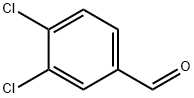
What is 3,4-Dichlorobenzaldehyde?
Chemical properties
white to slightly yellow low melting solid
The Uses of 3,4-Dichlorobenzaldehyde
3,4-Dichlorobenzaldehyde was used to design and prepare chalcone derivatives as potential antitumor agents, anti-inflammatory and cancer chemopreventive agents.
General Description
White crystalline solid or chunky powder.
Air & Water Reactions
3,4-Dichlorobenzaldehyde may be sensitive to prolonged exposure to air, light and moisture. Insoluble in water.
Reactivity Profile
3,4-Dichlorobenzaldehyde is incompatible with strong oxidizers and strong bases. 3,4-Dichlorobenzaldehyde may also be incompatible with iron.
Fire Hazard
3,4-Dichlorobenzaldehyde is probably combustible.
Properties of 3,4-Dichlorobenzaldehyde
| Melting point: | 39-42 °C (lit.) |
| Boiling point: | 247-248 °C (lit.) |
| Density | 1.3456 (rough estimate) |
| refractive index | 1.5756 (estimate) |
| Flash point: | >230 °F |
| storage temp. | 2-8°C |
| solubility | soluble in Methanol |
| form | Low Melting Solid |
| color | White to slightly yellow |
| Water Solubility | INSOLUBLE |
| Sensitive | Air Sensitive |
| BRN | 636379 |
| CAS DataBase Reference | 6287-38-3(CAS DataBase Reference) |
| NIST Chemistry Reference | Benzaldehyde, 3,4-dichloro-(6287-38-3) |
| EPA Substance Registry System | Benzaldehyde, 3,4-dichloro- (6287-38-3) |
Safety information for 3,4-Dichlorobenzaldehyde
| Signal word | Danger |
| Pictogram(s) |
 Corrosion Corrosives GHS05 |
| GHS Hazard Statements |
H314:Skin corrosion/irritation |
| Precautionary Statement Codes |
P260:Do not breathe dust/fume/gas/mist/vapours/spray. P280:Wear protective gloves/protective clothing/eye protection/face protection. P363:Wash contaminated clothing before reuse. P303+P361+P353:IF ON SKIN (or hair): Remove/Take off Immediately all contaminated clothing. Rinse SKIN with water/shower. P305+P351+P338:IF IN EYES: Rinse cautiously with water for several minutes. Remove contact lenses, if present and easy to do. Continuerinsing. |
Computed Descriptors for 3,4-Dichlorobenzaldehyde
New Products
2-(2-Chlorophenyl)glycine Propiolic Acid 1-(3-Hydroxy-4-methoxyphenyl)-2-nitroethene (±)-amino(2-fluorophenyl)acetic acid trans-3-Benzyloxy-4-methoxy-beta-nitrostyrene 1-Pentadecanol 4-(4-Αminophenyl)-3-Morpholinone 3-Morpholino-1-(4-(2-oxopiperidin-1-yl) phenyl)-5,6-dihyropyridin-2-(1H)-one 1-(4-Aminophenyl)-3-morpholino-5,6-dihydropyridin-2(1H)-one N-cyanoacetylurethane 1H-IndazoleRelated products of tetrahydrofuran


![OXALIC ACID BIS[2,4,5-TRICHLORO-6-(PENTYLOXYCARBONYL)PHENYL] ESTER](https://img.chemicalbook.in/CAS/GIF/30431-54-0.gif)
You may like
-
 6287-38-3 99%View Details
6287-38-3 -
3,4-Dichloro benzaldehyde CAS 6287-38-3View Details
6287-38-3 -
3,4-Dichlorobenzaldehyde CAS 6287-38-3View Details
6287-38-3 -
3,4-Dichlorobenzaldehyde CAS 6287-38-3View Details
6287-38-3 -
471-25-0 Propiolic Acid 98+View Details
471-25-0 -
2-(2-Chlorophenyl)glycine 88744-36-9 98+View Details
88744-36-9 -
40216-83-9 trans-4-Hydroxy-L-proline methyl ester hydrochloride 98+View Details
40216-83-9 -
1-(3-Hydroxy-4-methoxyphenyl)-2-nitroethene 98+View Details
39816-35-8
Statement: All products displayed on this website are only used for non medical purposes such as industrial applications or scientific research, and cannot be used for clinical diagnosis or treatment of humans or animals. They are not medicinal or edible.