
3,3-Dimethylpentane
- CAS NO.:562-49-2
- Empirical Formula: C7H16
- Molecular Weight: 100.2
- MDL number: MFCD00009322
- EINECS: 209-230-8
- SAFETY DATA SHEET (SDS)
- Update Date: 2026-05-28 03:28:50
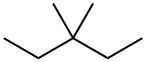
What is 3,3-Dimethylpentane?
Chemical properties
clear colorless liquid
Physical properties
Colorless, mobile liquid with an odor resembling heptane or gasoline. Evaporates when spilled forming combustible vapors.
The Uses of 3,3-Dimethylpentane
3,3-Dimethylpentane Is used in organic synthesis & as gasoline component, as Pharmaceutical intermediates. It was used in the development and evaluation of the epiocular-eye irritation test.
General Description
3,3-Dimethylpentane isomerizes via a methyl shift mechanism on oxygen-exposed tungsten carbides.
Environmental Fate
Chemical/Physical. Complete combustion in air yields carbon dioxide and water vapor. 3,3- Dimethylbutane will not hydrolyze because it has no hydrolyzable functional group.
Properties of 3,3-Dimethylpentane
| Melting point: | -135 °C (lit.) |
| Boiling point: | 86 °C (lit.) |
| Density | 0.693 g/mL at 25 °C (lit.) |
| vapor pressure | 2.77 psi ( 37.7 °C) |
| refractive index | n |
| Flash point: | 20 °F |
| storage temp. | Flammables area |
| solubility | Soluble in acetone, alcohol, benzene, chloroform, and ether (Weast, 1986) |
| form | Liquid |
| pka | >14 (Schwarzenbach et al., 1993) |
| color | Clear colorless |
| explosive limit | ~7% |
| Water Solubility | Soluble in acetone, water, chloroform, alcohol & ether. In water ( 5.92 mg/kg ) dissolves at 25°C. |
| BRN | 1696854 |
| Henry's Law Constant | 1.85(atm?m3/mol) at 25 °C (Mackay and Shiu, 1981) |
| Exposure limits | ACGIH: TWA 400 ppm; STEL 500 ppm |
| Dielectric constant | 1.9399999999999999 |
| EPA Substance Registry System | Pentane, 3,3-dimethyl- (562-49-2) |
Safety information for 3,3-Dimethylpentane
| Signal word | Danger |
| Pictogram(s) |
 Flame Flammables GHS02  Exclamation Mark Irritant GHS07  Health Hazard GHS08  Environment GHS09 |
| GHS Hazard Statements |
H225:Flammable liquids H304:Aspiration hazard H315:Skin corrosion/irritation H336:Specific target organ toxicity,single exposure; Narcotic effects H410:Hazardous to the aquatic environment, long-term hazard |
| Precautionary Statement Codes |
P210:Keep away from heat/sparks/open flames/hot surfaces. — No smoking. P233:Keep container tightly closed. P273:Avoid release to the environment. P331:Do NOT induce vomiting. P301+P310:IF SWALLOWED: Immediately call a POISON CENTER or doctor/physician. P303+P361+P353:IF ON SKIN (or hair): Remove/Take off Immediately all contaminated clothing. Rinse SKIN with water/shower. |
Computed Descriptors for 3,3-Dimethylpentane
New Products
2-Bromo-4-hydroxypyridine Dibenzoyl-L-tartaric acid Anhydrous (Resolution Reagent) Dibenzo[b,f][1,4]thiazepin-11(10H)-one 1,2,3,9-Tetrahydro-9-Methyl-4H-Carbazole-4-One Cis-Tosylate 1-(4-methoxyphenyl)-4-(4-Nitrophenyl)Piperazine (IT-1) 2'-Fluoroacetophenone 1-aminocyclobutanecarbonitrile hydrochloride AMINO-O-TOLYL-ACETIC ACID N-Methyl-2-amino-2-methylpropionamide 4-(FMOC-AMINO)-TETRAHYDROPYRAN-4-CARBOXYLIC ACID 1-Aminocyclobutanecarboxylic Acid Hydrochloride METHANOL-D1(OD) TERTIARY BUTANOL-D9 N-ETHYL-D5-AMINE HYDROCHLORIDE BENZOIC ACID-D CHLOROFORM-D TOLUENE-D3 2-(2-Bromophenyl)ethanol Boc-D-Glu(OMe)-OMe 2,5 Dibromopyridine Ethyl 4-hydroxy-3-oxobutanoate Dimethyl (2S)-2-((tert-butoxycarbonyl)amino)-4-(cyanomethyl)pentanedioate 1-(3-Chlorophenyl)piperazine hydrochlorideRelated products of tetrahydrofuran

You may like
-
 3,3-Dimethylpentane CAS 562-49-2View Details
562-49-2 -
98071-16-0 1-Aminocyclobutanecarboxylic Acid Hydrochloride 98+View Details
98071-16-0 -
106914-07-2 N-Methyl-2-amino-2-methylpropionamide 98+View Details
106914-07-2 -
129592-98-9 98+View Details
129592-98-9 -
4-(FMOC-AMINO)-TETRAHYDROPYRAN-4-CARBOXYLIC ACID 98+View Details
285996-72-7 -
1-aminocyclobutanecarbonitrile hydrochloride 845821-84-3 98+View Details
845821-84-3 -
98071-16-0 1-Aminocyclobutanecarboxylic Acid Hydrochloride 98+View Details
98071-16-0 -
 ADC-151View Details
27176-87-0
Statement: All products displayed on this website are only used for non medical purposes such as industrial applications or scientific research, and cannot be used for clinical diagnosis or treatment of humans or animals. They are not medicinal or edible.