
3-deazaneplanocin
Synonym(s):;InSolution EZH2 Inhibitor, DZNep - CAS 102052-95-9 - Calbiochem
- CAS NO.:102052-95-9
- Empirical Formula: C12H14N4O3
- Molecular Weight: 262.26
- MDL number: MFCD12545899
- SAFETY DATA SHEET (SDS)
- Update Date: 2026-05-28 03:12:49
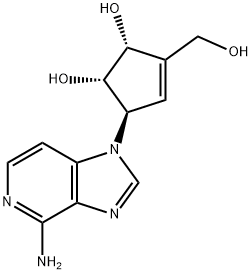
What is 3-deazaneplanocin?
Description
DZNep (102052-95-9) is a potent histone methyltransferase inhibitor which decreases global histone methylation.1?Inhibits trimethylation of H3K27 and H4K20?in vitro.1?Selectively induces apoptosis in multiple cancer cell lines with no effect on normal cells.2?DZNep may be used in cocktails to chemically induce pluripotent stem cells (CiPSCs) from somatic cells.3?Enhances angiogenesis in a mouse model of limb ischemia.4
General Description
A cell-permeable compound that is shown (at 1 μM concentrations) to inhibit EZH2-mediated trimethylation of K27 on histone H3 and induces the expression of cell-cycle regulatory genes, p21 and p27, as well as the cell death regulator, FBXO32, in OCI-AML3 and HL-60 cells, whereby treatment with inhibitor increases p16 levels in the former, but not the latter of the two cultures. At concentrations between 200 nm and 2000 nM, this compound is found to dose-dependently deplete the expression of polycomb group proteins EZH2, SUZ12, and EED in cultured and primary AML cell extracts. At concentrations up to ≥ 1000 nM, DZNep dose-dependently increases the percentage of apoptotic cells up to > ~ 38%, with greater potency against OCI-AML3 than HL-60 cultures and inhibits colony growth up to > ~ 85% for both cell lines. In OCI-AML3 cultures, 1000 nM of treatment demonstrates a significant increase in the accumulation of cells in the G0/G1 phase (58.5%) with a concomitant decrease in the number of cells in S phase (35.2%) and G2/M phases (6.3%) of the cell cycle. When co-treated with panobinostat (PS), 200 nM to 1000nM DZNep is shown to decrease cell viability in OCI-AML3 and HL-60 cultures more effectively than DZNep alone, in a dose-dependent manner. DZNep (1mg/kg, twice per week, i.p.) and PS significantly prolong the survival of mice implanted with HL-60 cells compared to treatment with either compound alone. DZNep is also a known S-adenosyl-L-homocysteine (AdoHcy) hydrolase inhibitor.
Biochem/physiol Actions
Cell permeable: yes
References
1) Miranda?et al.?(2009),?DZNep is a global histone methylation inhibitor that reactivates developmental genes not silenced by DNA methylation; Mol. Cancer Ther.,?8?1579 2) Tan?et al.?(2007),?Pharmacologic disruption of Polycomb-repressive complex 2-mediated gene repression selectively induces apoptosis in cancer cells; Genes Dev.,?21?1050 3) Hou?et al. (2013),?Pluripotent stem cells induced from mouse somatic cells by small-molecule compounds; Science,?341?651 4) Mitic?et al. (2015),?EZH2 modulates angiogenesis in vitro and in a mouse model of limb ischemia; Mol. Ther.,?23?32
Properties of 3-deazaneplanocin
| Boiling point: | 624.1±65.0 °C(Predicted) |
| Density | 1.75 |
| storage temp. | = -70C |
| solubility | Soluble in DMSO (up to 20 mg/ml) |
| form | Liquid |
| pka | 13.52±0.70(Predicted) |
| color | Beige |
| Water Solubility | Soluble in Water |
| Stability: | Stable for 1 year from date of purchase as supplied. Solutions in DMSO may be stored at -20°C for up to 1 month. |
Safety information for 3-deazaneplanocin
Computed Descriptors for 3-deazaneplanocin
New Products
Dibenzoyl-L-tartaric acid Anhydrous (Resolution Reagent) Cis-Tosylate Dibenzo[b,f][1,4]thiazepin-11(10H)-one 1,2,3,9-Tetrahydro-9-Methyl-4H-Carbazole-4-One 1-(4-methoxyphenyl)-4-(4-Nitrophenyl)Piperazine (IT-1) BOC Piperazine 1-Benzhydrylazetane-3-carbonitrile 8-oxa-1,3-diazaspiro[4.5]decane-2,4-dione (±)-amino(2-fluorophenyl)acetic acid 2-(2-Chlorophenyl)glycine AMINO-(3-CHLORO-PHENYL)-ACETIC ACID 2'-Fluoroacetophenone METHANOL-D1(OD) TERTIARY BUTANOL-D9 N-ETHYL-D5-AMINE HYDROCHLORIDE BENZOIC ACID-D CHLOROFORM-D TOLUENE-D3 Trans,trans muconic acid HC Blue-16 4-Amino-2-chloro-6,7-dimethoxyquinazoline Ethyl 4,5-bis(2-methoxyethoxy)-2-nitrobenzoate 2,3-Dimethoxypyridine 1-(3-Chlorophenyl)piperazine hydrochlorideRelated products of tetrahydrofuran

You may like
-
 3-Deazaneplanocin A hydrochloride CAS 102052-95-9View Details
102052-95-9 -
 Product IntroductionView Details
 -
 Product InrtroductionView Details
 -
 DGO24View Details
 -
 DGO25View Details
 -
 DGO29View Details
 -
 DGO32View Details
 -
 DGO36View Details