
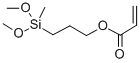
3-(Acryloyloxy)propyltrimethoxysilane
Synonym(s):(3-Acryloyloxypropyl)trimethoxysilane
- CAS NO.:4369-14-6
- Empirical Formula: C9H18O5Si
- Molecular Weight: 234.32
- MDL number: MFCD00054803
- EINECS: 419-560-6
- SAFETY DATA SHEET (SDS)
- Update Date: 2026-09-12 18:53:30
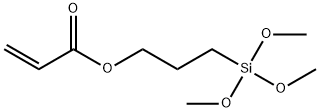
What is 3-(Acryloyloxy)propyltrimethoxysilane?
Chemical properties
Colorless transparent liquid
The Uses of 3-(Acryloyloxy)propyltrimethoxysilane
3-(Acryloyloxy)propyltrimethoxysilane is used to enhance the thermal conductivity of silicone rubber filled with hybrid fillers. It is involved in the synthesis of vinyl and acryalte modified silica nanoparticles by using vinyltrimethoxysilane. Further, it is used as a silane coupling agent involved in the modification of fluorescein isothiocyanate-mesoporous silica nanoparticles with carbon-carbon double bonds.
General Description
3-(Trimethoxysilyl)propyl acrylate is a reactive monomer that is majorly used as a silane coupling agent for the formation of hybrid compounds. It facilitates the formation of a hydrophobic surface by lowering the surface tension and increasing the wettability.
Properties of 3-(Acryloyloxy)propyltrimethoxysilane
| Boiling point: | 68 °C0.4 mm Hg(lit.) |
| Density | 1.055 g/mL at 25 °C(lit.) |
| vapor pressure | 20.5Pa at 25℃ |
| refractive index | n |
| Flash point: | >230 °F |
| storage temp. | Inert atmosphere,2-8°C |
| solubility | Miscible with organic solvents. |
| form | Liquid |
| color | Clear colorless |
| Specific Gravity | 1.0 |
| Water Solubility | 5.8-4300mg/L at 20℃ |
| Sensitive | Moisture Sensitive |
| Hydrolytic Sensitivity | 7: reacts slowly with moisture/water |
| BRN | 2046320 |
| CAS DataBase Reference | 4369-14-6(CAS DataBase Reference) |
| EPA Substance Registry System | 2-Propenoic acid, 3-(trimethoxysilyl)propyl ester (4369-14-6) |
Safety information for 3-(Acryloyloxy)propyltrimethoxysilane
| Signal word | Danger |
| Pictogram(s) |
 Corrosion Corrosives GHS05  Exclamation Mark Irritant GHS07 |
| GHS Hazard Statements |
H314:Skin corrosion/irritation H317:Sensitisation, Skin H332:Acute toxicity,inhalation H412:Hazardous to the aquatic environment, long-term hazard |
| Precautionary Statement Codes |
P261:Avoid breathing dust/fume/gas/mist/vapours/spray. P273:Avoid release to the environment. P280:Wear protective gloves/protective clothing/eye protection/face protection. P303+P361+P353:IF ON SKIN (or hair): Remove/Take off Immediately all contaminated clothing. Rinse SKIN with water/shower. P305+P351+P338:IF IN EYES: Rinse cautiously with water for several minutes. Remove contact lenses, if present and easy to do. Continuerinsing. |
Computed Descriptors for 3-(Acryloyloxy)propyltrimethoxysilane
New Products
5-bromo-4-fluoro-2-nitrobenzaldehyde (R)-(-)-2-Amino-1-propanol Cyclobutanone Fmoc-OSu 1-(2-Chloroethyl)pyrrolidine Hydrochloride 2-Amino-2-(4-methylphenyl)acetic acid β-Bromostyrene Ethyl 3-phenylpropanoate Phenethyl cinnamate Dipropyl disulfide 4 pentyn 1 ol N-Vinylformamide Methacrylate-PEG-Methacrylate, Mn:35000 2,4-Dihydroxyacetophenone 2-Chloro 5-Fluoro Pyridine Vasicinone 2-Chloroisonicotinic Acid Tween 80 or Polysorbate 80 2-Butyn-1-oL 2-Pentyn-1-oL 4-Nitrobenzotrifluoride N-(4-fluoro-2-methoxy-5-nitrophenyl)-4-(1-methyl-1H-indol-3-yl)pyrimidin-2-amine Pirtobrutinib intd. N-(4-Cyano-3-(trifluoromethyl)phenyl)-2-methyloxirane-2-carboxamideRelated products of tetrahydrofuran
You may like
-
 3-(Trimethoxysilyl)propyl Acrylate (stabilized with BHT) CAS 4369-14-6View Details
4369-14-6 -
3-(Acryloyloxy)propyltrimethoxysilane, stabilized with 100ppm BHT CAS 4369-14-6View Details
4369-14-6 -
(3-Acryloyloxypropyl)trimethoxysilane, 98% CAS 4369-14-6View Details
4369-14-6 -
3-(Trimethoxysilyl)propyl acrylate CAS 4369-14-6View Details
4369-14-6 -
7250-67-1 1-(2-Chloroethyl)pyrrolidine Hydrochloride 98+View Details
7250-67-1 -
13227-01-5 98+View Details
13227-01-5 -
7250-67-1 1-(2-Chloroethyl)pyrrolidine Hydrochloride 98+View Details
7250-67-1 -
13227-01-5 98+View Details
13227-01-5
Statement: All products displayed on this website are only used for non medical purposes such as industrial applications or scientific research, and cannot be used for clinical diagnosis or treatment of humans or animals. They are not medicinal or edible.