
3-(4-Fluorobenzoyl)propionic acid
Synonym(s):Haloperidol metabolite III;R 11302
- CAS NO.:366-77-8
- Empirical Formula: C10H9FO3
- Molecular Weight: 196.18
- MDL number: MFCD00002793
- EINECS: 206-679-1
- SAFETY DATA SHEET (SDS)
- Update Date: 2026-09-12 18:56:28
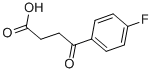
What is 3-(4-Fluorobenzoyl)propionic acid?
Chemical properties
beige granular powder
The Uses of 3-(4-Fluorobenzoyl)propionic acid
7-Fluoro-1-tetralone was prepared from 3-(4-fluorobenzoyl)-propionic acid by Wolff-Kishner reduction followed by ring closure with polyphosphoric acid and other substituted 1-tetralones where commercially available. Reduction of 3-(4-fluorobenzoyl)propionic acid with an excess of tert-butylamine borane (TBAB) in the presence of AlCl3 provided 4-(4-fluorophenyl)-1-butanol (87) in 63% yield for the synthesis of LM-1507 sodium salt. Penfluridol 1-[4,4-bis(4-fluorophenyl)butyl]-4-(4-chloro-3-trifluoromethylphenyl)- 4-hydroxypiperidine, C 28 H 27 ClF 5 NO, M r 523.99, mp 105 - 107°C, is obtained by reducing the ketone of 3-(4-fluorobenzoyl)propionic acid into a lactone.
What are the applications of Application
3-(4-Fluorobenzoyl)propionic acid is a metabolite of haloperidol
Definition
ChEBI: 4-(4-Fluorophenyl)-4-oxobutanoic acid is an aromatic ketone.
General Description
3-(4-Fluorobenzoyl)propionic acid is a metabolite of haloperidol, a dopamine D2 receptor blocker.
Properties of 3-(4-Fluorobenzoyl)propionic acid
| Melting point: | 100-102 °C (lit.) |
| Boiling point: | 374.4±22.0 °C(Predicted) |
| Density | 1.2441 (estimate) |
| storage temp. | Sealed in dry,Room Temperature |
| solubility | Chloroform (Slightly), Methanol (Slightly) |
| pka | 4.50±0.17(Predicted) |
| form | powder to crystal |
| color | White to Orange to Green |
| Water Solubility | Insoluble in water. |
| BRN | 958145 |
| CAS DataBase Reference | 366-77-8(CAS DataBase Reference) |
Safety information for 3-(4-Fluorobenzoyl)propionic acid
| Signal word | Warning |
| Pictogram(s) |
 Exclamation Mark Irritant GHS07 |
| GHS Hazard Statements |
H302:Acute toxicity,oral H315:Skin corrosion/irritation H319:Serious eye damage/eye irritation H335:Specific target organ toxicity, single exposure;Respiratory tract irritation |
| Precautionary Statement Codes |
P264:Wash hands thoroughly after handling. P264:Wash skin thouroughly after handling. P280:Wear protective gloves/protective clothing/eye protection/face protection. P305+P351+P338:IF IN EYES: Rinse cautiously with water for several minutes. Remove contact lenses, if present and easy to do. Continuerinsing. |
Computed Descriptors for 3-(4-Fluorobenzoyl)propionic acid
3-(4-Fluorobenzoyl)propionic acid manufacturer
SOBHA BIO
New Products
2-(2-Chlorophenyl)glycine Propiolic Acid 1-(3-Hydroxy-4-methoxyphenyl)-2-nitroethene (±)-amino(2-fluorophenyl)acetic acid trans-3-Benzyloxy-4-methoxy-beta-nitrostyrene 1-Pentadecanol 4-(4-Αminophenyl)-3-Morpholinone 3-Morpholino-1-(4-(2-oxopiperidin-1-yl) phenyl)-5,6-dihyropyridin-2-(1H)-one 1-(4-Aminophenyl)-3-morpholino-5,6-dihydropyridin-2(1H)-one N-cyanoacetylurethane 1H-IndazoleRelated products of tetrahydrofuran



You may like
-
 3-(4-Fluorobenzoyl)propionic Acid CAS 366-77-8View Details
366-77-8 -
4-(4-Fluorophenyl)-4-oxobutanoic acid 366-77-8 98%View Details
366-77-8 -
471-25-0 Propiolic Acid 98+View Details
471-25-0 -
84145-28-8 98+View Details
84145-28-8 -
trans-3-Benzyloxy-4-methoxy-beta-nitrostyrene 98+View Details
63909-29-5 -
2-(2-Chlorophenyl)glycine 88744-36-9 98+View Details
88744-36-9 -
40216-83-9 trans-4-Hydroxy-L-proline methyl ester hydrochloride 98+View Details
40216-83-9 -
1-(3-Hydroxy-4-methoxyphenyl)-2-nitroethene 98+View Details
39816-35-8