
2,6-Dimethyl-1-nitrobenzene
Synonym(s):2-Nitro-m-xylene
- CAS NO.:81-20-9
- Empirical Formula: C8H9NO2
- Molecular Weight: 151.16
- MDL number: MFCD00007181
- EINECS: 201-333-6
- SAFETY DATA SHEET (SDS)
- Update Date: 2026-05-28 03:00:58
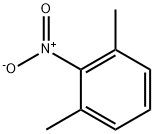
What is 2,6-Dimethyl-1-nitrobenzene?
Chemical properties
colourless to light yellow liquid
The Uses of 2,6-Dimethyl-1-nitrobenzene
2-Nitro-m-xylene is employed as a pharmaceutical intermediate in organic synthesis. It is also used in the preparation of Direct Violet 7 and solvent Red 26. Further, it is used in the petrochemical industry.
General Description
Clear yellow liquid.
Air & Water Reactions
Insoluble in water.
Reactivity Profile
2,6-Dimethyl-1-nitrobenzene is incompatible with strong oxidizers and strong bases.
Fire Hazard
2,6-Dimethyl-1-nitrobenzene is combustible.
Safety Profile
Poison by intravenous route.When heated to decomposition it emits toxic fumes ofNOx.
Properties of 2,6-Dimethyl-1-nitrobenzene
| Melting point: | 14-16 °C(lit.) |
| Boiling point: | 225 °C744 mm Hg(lit.) |
| Density | 1.112 g/mL at 25 °C(lit.) |
| refractive index | n |
| Flash point: | 190 °F |
| storage temp. | Store below +30°C. |
| solubility | Chloroform (Soluble), Methanol (Slightly) |
| form | neat |
| color | White or Colorless to Yellow |
| Water Solubility | insoluble |
| BRN | 2046066 |
| Stability: | Stable. Incompatible with strong oxidizing agents. |
| CAS DataBase Reference | 81-20-9(CAS DataBase Reference) |
| NIST Chemistry Reference | Benzene, 1,3-dimethyl-2-nitro-(81-20-9) |
| EPA Substance Registry System | 2-Nitro-m-xylene (81-20-9) |
Safety information for 2,6-Dimethyl-1-nitrobenzene
| Signal word | Warning |
| Pictogram(s) |
 Exclamation Mark Irritant GHS07  Environment GHS09 |
| GHS Hazard Statements |
H302:Acute toxicity,oral H411:Hazardous to the aquatic environment, long-term hazard |
| Precautionary Statement Codes |
P264:Wash hands thoroughly after handling. P264:Wash skin thouroughly after handling. P270:Do not eat, drink or smoke when using this product. P273:Avoid release to the environment. P391:Collect spillage. Hazardous to the aquatic environment P301+P312:IF SWALLOWED: call a POISON CENTER or doctor/physician IF you feel unwell. P501:Dispose of contents/container to..… |
Computed Descriptors for 2,6-Dimethyl-1-nitrobenzene
| InChIKey | HDFQKJQEWGVKCQ-UHFFFAOYSA-N |
New Products
5-bromo-4-fluoro-2-nitrobenzaldehyde (R)-(-)-2-Amino-1-propanol Cyclobutanone Fmoc-OSu 1-(2-Chloroethyl)pyrrolidine Hydrochloride 2-Amino-2-(4-methylphenyl)acetic acid β-Bromostyrene Ethyl 3-phenylpropanoate Phenethyl cinnamate Dipropyl disulfide 4 pentyn 1 ol N-Vinylformamide Methacrylate-PEG-Methacrylate, Mn:35000 2,4-Dihydroxyacetophenone 2-Chloro 5-Fluoro Pyridine Vasicinone 2-Chloroisonicotinic Acid Tween 80 or Polysorbate 80 2-Butyn-1-oL 2-Pentyn-1-oL 4-Nitrobenzotrifluoride N-(4-fluoro-2-methoxy-5-nitrophenyl)-4-(1-methyl-1H-indol-3-yl)pyrimidin-2-amine Pirtobrutinib intd. N-(4-Cyano-3-(trifluoromethyl)phenyl)-2-methyloxirane-2-carboxamideRelated products of tetrahydrofuran


You may like
-
 2-Nitro-m-xylene CAS 81-20-9View Details
81-20-9 -
1,3-Dimethyl-2-nitrobenzene CAS 81-20-9View Details
81-20-9 -
7250-67-1 1-(2-Chloroethyl)pyrrolidine Hydrochloride 98+View Details
7250-67-1 -
13227-01-5 98+View Details
13227-01-5 -
7250-67-1 1-(2-Chloroethyl)pyrrolidine Hydrochloride 98+View Details
7250-67-1 -
13227-01-5 98+View Details
13227-01-5 -
7250-67-1 1-(2-Chloroethyl)pyrrolidine Hydrochloride 98+View Details
7250-67-1 -
13227-01-5 98+View Details
13227-01-5
Statement: All products displayed on this website are only used for non medical purposes such as industrial applications or scientific research, and cannot be used for clinical diagnosis or treatment of humans or animals. They are not medicinal or edible.