
2,4-Dinitrobenzenesulfonyl chloride
- CAS NO.:1656-44-6
- Empirical Formula: C6H3ClN2O6S
- Molecular Weight: 266.62
- MDL number: MFCD00007431
- EINECS: 216-749-3
- SAFETY DATA SHEET (SDS)
- Update Date: 2026-09-12 18:48:20
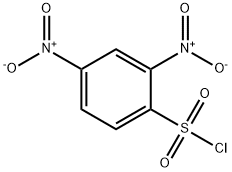
What is 2,4-Dinitrobenzenesulfonyl chloride?
Chemical properties
yellow crystalline powder
The Uses of 2,4-Dinitrobenzenesulfonyl chloride
2,4-Dinitrobenzenesulfonyl chloride was used to protect primary amines. It was used as starting reagent in the synthesis of tert-butyl 2-[(2,4-dinitrophenyl) sulfonyl]amino acetate.
What are the applications of Application
2,4-Dinitrobenzenesulfonyl chloride is a dinitro sulfonic acid halide
General Description
2,4-Dinitrobenzenesulfonyl chloride causes the sulfonation of glycosylamines to yield N-glycosyl-2,4-dinitrobenzenesulfonamides.
Purification Methods
Crystallise the sulfonyl chloride from *benzene or *benzene/pet ether. [Beilstein 11 H 78, 11 IV 214.]
Properties of 2,4-Dinitrobenzenesulfonyl chloride
| Melting point: | 101-103 °C (lit.) |
| Boiling point: | 60-80 °C |
| Density | 1.780 |
| storage temp. | -20°C Freezer |
| solubility | Chloroform (Slightly) |
| form | Solid |
| color | Light Yellow Crystalline |
| Water Solubility | Reacts with water. |
| Sensitive | Moisture Sensitive |
| BRN | 2147583 |
| Stability: | Hygroscopic |
| CAS DataBase Reference | 1656-44-6(CAS DataBase Reference) |
| EPA Substance Registry System | Benzenesulfonyl chloride, 2,4-dinitro- (1656-44-6) |
Safety information for 2,4-Dinitrobenzenesulfonyl chloride
| Signal word | Danger |
| Pictogram(s) |
 Corrosion Corrosives GHS05  Health Hazard GHS08 |
| GHS Hazard Statements |
H314:Skin corrosion/irritation H340:Germ cell mutagenicity H350:Carcinogenicity H373:Specific target organ toxicity, repeated exposure |
| Precautionary Statement Codes |
P202:Do not handle until all safety precautions have been read and understood. P260:Do not breathe dust/fume/gas/mist/vapours/spray. P280:Wear protective gloves/protective clothing/eye protection/face protection. P303+P361+P353:IF ON SKIN (or hair): Remove/Take off Immediately all contaminated clothing. Rinse SKIN with water/shower. P305+P351+P338:IF IN EYES: Rinse cautiously with water for several minutes. Remove contact lenses, if present and easy to do. Continuerinsing. |
Computed Descriptors for 2,4-Dinitrobenzenesulfonyl chloride
New Products
5-bromo-4-fluoro-2-nitrobenzaldehyde (R)-(-)-2-Amino-1-propanol Cyclobutanone Fmoc-OSu 1-(2-Chloroethyl)pyrrolidine Hydrochloride 2-Amino-2-(4-methylphenyl)acetic acid β-Bromostyrene Ethyl 3-phenylpropanoate Phenethyl cinnamate Dipropyl disulfide 4 pentyn 1 ol N-Vinylformamide Methacrylate-PEG-Methacrylate, Mn:35000 2,4-Dihydroxyacetophenone 2-Chloro 5-Fluoro Pyridine Vasicinone 2-Chloroisonicotinic Acid Tween 80 or Polysorbate 80 2-Butyn-1-oL 2-Pentyn-1-oL 4-Nitrobenzotrifluoride N-(4-fluoro-2-methoxy-5-nitrophenyl)-4-(1-methyl-1H-indol-3-yl)pyrimidin-2-amine Pirtobrutinib intd. N-(4-Cyano-3-(trifluoromethyl)phenyl)-2-methyloxirane-2-carboxamideRelated products of tetrahydrofuran
You may like
-
 Fmoc-OSu 98+View Details
82911-69-1 -
(R)-(-)-2-Amino-1-propanol 35320-23-1 98+View Details
35320-23-1 -
7250-67-1 1-(2-Chloroethyl)pyrrolidine Hydrochloride 98+View Details
7250-67-1 -
13227-01-5 98+View Details
13227-01-5 -
7250-67-1 1-(2-Chloroethyl)pyrrolidine Hydrochloride 98+View Details
7250-67-1 -
13227-01-5 98+View Details
13227-01-5 -
7250-67-1 1-(2-Chloroethyl)pyrrolidine Hydrochloride 98+View Details
7250-67-1 -
13227-01-5 98+View Details
13227-01-5
Statement: All products displayed on this website are only used for non medical purposes such as industrial applications or scientific research, and cannot be used for clinical diagnosis or treatment of humans or animals. They are not medicinal or edible.