
2,3-DICHLORO-1-PROPANOL
Synonym(s):Glycerol-α,β-dichlorohydrin
- CAS NO.:616-23-9
- Empirical Formula: C3H6Cl2O
- Molecular Weight: 128.99
- MDL number: MFCD00040446
- EINECS: 210-470-0
- SAFETY DATA SHEET (SDS)
- Update Date: 2026-05-27 23:14:16
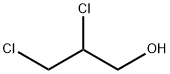
What is 2,3-DICHLORO-1-PROPANOL?
Chemical properties
CLEAR COLORLESS LIQUID
Chemical properties
There are 4 isomers of dichloropropanols 1,3- dichloro-2-propanol (96-23-1) and “dichloropropanols” (26545-73-3) are citations in environmental regulations: C3H6OCl2 is a colorless viscous liquid with a chloroformlike odor. Slightly soluble in water. 1,3-Dichloro-2- propanol:
The Uses of 2,3-DICHLORO-1-PROPANOL
2,3-Dichloro-1-propanol may be employed as carbon and energy supplement for the growth of Pseudomonas putida strain (MC4).
The Uses of 2,3-DICHLORO-1-PROPANOL
An isomer of dichloropropanol; shows metabolite toxicity.
What are the applications of Application
2,3-Dichloro-1-propanol is a useful chemical for synthesis that can also be used as a carbon and energy supplement for the growth of Pseudomonas putida strain (MC4)
General Description
Viscous colorless to amber liquid with an ethereal odor.
Air & Water Reactions
May be sensitive to prolonged exposure to air. Slightly soluble in water.
Reactivity Profile
2,3-DICHLORO-1-PROPANOL is incompatible with oxidizers, oxygen and peroxides.
Fire Hazard
2,3-DICHLORO-1-PROPANOL is combustible.
Safety Profile
Poison by ingestion and skin contact. Moderately toxic by inhalation. A skin and severe eye irritant. Mutation data reported. When heated to decomposition it emits toxic fumes of Cl-. See also CHLORINATED HYDROCARBONS, AROMATIC.
Potential Exposure
It is used as a solvent for hard resins and nitrocellulose; in the manufacture of photographic chemicals and lacquer; as a cement for celluloid; and as a binder of water colors. It occurs in effluents from glycerol and halohydrin production plants.
Shipping
UN2750 1,3-Dichloropropanol-2, Hazard Class: 6.1; Labels: 6.1-Poisonous materials
Incompatibilities
Incompatible with oxidizers (chlorates, nitrates, peroxides, permanganates, perchlorates, chlorine, bromine, fluorine, etc.); contact may cause fires orexplosions. Keep away from alkaline materials, strong acids, acid anhydrides, strong bases
Properties of 2,3-DICHLORO-1-PROPANOL
| Melting point: | -29.15°C |
| Boiling point: | 182 °C |
| Density | 1.360 g/mL at 20 °C (lit.) |
| refractive index | 1.4835-1.4855 |
| Flash point: | 93 °C |
| storage temp. | Sealed in dry,2-8°C |
| solubility | 1-10g/l |
| pka | 13.75±0.10(Predicted) |
| form | Liquid |
| color | Clear colorless |
| BRN | 1732060 |
| CAS DataBase Reference | 616-23-9(CAS DataBase Reference) |
| EPA Substance Registry System | 2,3-Dichloropropanol (616-23-9) |
Safety information for 2,3-DICHLORO-1-PROPANOL
| Signal word | Danger |
| Pictogram(s) |
 Skull and Crossbones Acute Toxicity GHS06 |
| GHS Hazard Statements |
H301:Acute toxicity,oral H310:Acute toxicity,dermal H319:Serious eye damage/eye irritation |
| Precautionary Statement Codes |
P262:Do not get in eyes, on skin, or on clothing. P280:Wear protective gloves/protective clothing/eye protection/face protection. P305+P351+P338:IF IN EYES: Rinse cautiously with water for several minutes. Remove contact lenses, if present and easy to do. Continuerinsing. |
Computed Descriptors for 2,3-DICHLORO-1-PROPANOL
New Products
1-(4-methoxyphenyl)-4-(4-Nitrophenyl)Piperazine (IT-1) 1,2,3,9-Tetrahydro-9-Methyl-4H-Carbazole-4-One Dibenzo[b,f][1,4]thiazepin-11(10H)-one Cis-Tosylate Dibenzoyl-L-tartaric acid Anhydrous (Resolution Reagent) 1-Benzhydrylazetane-3-carbonitrile 8-oxa-1,3-diazaspiro[4.5]decane-2,4-dione (±)-amino(2-fluorophenyl)acetic acid 2-(2-Chlorophenyl)glycine AMINO-(3-CHLORO-PHENYL)-ACETIC ACID 2'-Fluoroacetophenone METHANOL-D1(OD) N-ETHYL-D5-AMINE HYDROCHLORIDE BENZOIC ACID-D CHLOROFORM-D BENZENE-D6 TOLUENE-D3 2-Hydroxybutanenitrile 1-Benzylindolin-2-one Ethyl 2-bromo-3-oxobutanoate 4-(3-chloropropyl)morpholine 1-Benzylindoline-2,3-dione 3-Oxocyclobutanecarboxylic acid 1-(3-Chlorophenyl)piperazine hydrochlorideRelated products of tetrahydrofuran
![1,9,10,11-TETRACHLORO-12,12-DIMETHOXY-5-OXATETRACYCLO[7.2.1.0(2,8).0(4,6)]DODEC-10-ENE-3,7-DIONE](https://img.chemicalbook.in/StructureFile/ChemBookStructure8/GIF/CB6342090.gif)

![1,8,9,10-TETRACHLORO-11,11-DIMETHOXYTRICYCLO[6.2.1.0(2,7)]UNDECA-4,9-DIENE-3,6-DIONE](https://img.chemicalbook.in/StructureFile/ChemBookStructure2/GIF/CB0226233.gif)
You may like
-
 2,3-Dichloro-1-propanol CAS 616-23-9View Details
616-23-9 -
5-Bromo-2-chloro- benzoic acid 21739-92-4 98%View Details
21739-92-4 -
Guar Hydroxypropyltrimonium Chloride 98%View Details
65497-29-2 -
52092-43-0 2-Bromo-4-nitropyridine-N-oxide 98%View Details
52092-43-0 -
2,4,6-Trichloro-5-nitropyrimidine 98%View Details
4359-87-9 -
ethyl 2-amino-4-methoxy-5-(3-morpholinopropoxy)benzoate 1040264-49-0 98%View Details
1040264-49-0 -
1-Methylpiperidine-4-thiol 1072-99-7 98%View Details
1072-99-7 -
68886-07-7 98%View Details
68886-07-7