
2-Propylzinc bromide solution 0.5M in t&
Synonym(s):Isopropylzinc bromide
- CAS NO.:77047-87-1
- Empirical Formula: C3H7BrZn
- Molecular Weight: 188.37
- MDL number: MFCD06200639
- SAFETY DATA SHEET (SDS)
- Update Date: 2026-09-12 18:50:06
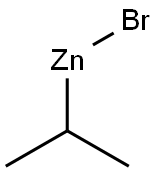
What is 2-Propylzinc bromide solution 0.5M in t&?
The Uses of 2-Propylzinc bromide solution 0.5M in t&
Isopropylzinc bromide is employed in croos-coupling reactions.
The Uses of 2-Propylzinc bromide solution 0.5M in t&
2-Propylzinc bromide solution (0.5 M in THF) has been used as a reagent in a protocol for the nickel-catalyzed dehalogenation of organic halides.
Properties of 2-Propylzinc bromide solution 0.5M in t&
| Density | 0.963 g/mL at 25 °C |
| Flash point: | -20 °C |
| storage temp. | 2-8°C |
| Water Solubility | Reacts with water. |
| Sensitive | Air Sensitive |
| Exposure limits | ACGIH: TWA 50 ppm; STEL 100 ppm (Skin) OSHA: TWA 200 ppm(590 mg/m3) NIOSH: IDLH 2000 ppm; TWA 200 ppm(590 mg/m3); STEL 250 ppm(735 mg/m3) |
| CAS DataBase Reference | 77047-87-1 |
Safety information for 2-Propylzinc bromide solution 0.5M in t&
| Signal word | Danger |
| Pictogram(s) |
 Flame Flammables GHS02  Corrosion Corrosives GHS05  Exclamation Mark Irritant GHS07  Health Hazard GHS08 |
| GHS Hazard Statements |
H225:Flammable liquids H261:Substances And Mixtures Which, In Contact With Water,Emit Flammable Gases H302:Acute toxicity,oral H314:Skin corrosion/irritation H318:Serious eye damage/eye irritation H333:Acute toxicity,inhalation H335:Specific target organ toxicity, single exposure;Respiratory tract irritation H351:Carcinogenicity |
| Precautionary Statement Codes |
P210:Keep away from heat/sparks/open flames/hot surfaces. — No smoking. P223:Keep away from any possible contact with water, because of violent reaction and possible flash fire. P280:Wear protective gloves/protective clothing/eye protection/face protection. P231+P232:Handle under inert gas. Protect from moisture. P303+P361+P353:IF ON SKIN (or hair): Remove/Take off Immediately all contaminated clothing. Rinse SKIN with water/shower. P305+P351+P338:IF IN EYES: Rinse cautiously with water for several minutes. Remove contact lenses, if present and easy to do. Continuerinsing. P370+P378:In case of fire: Use … for extinction. P405:Store locked up. P402+P404:Store in a dry place. Store in a closed container. P403+P235:Store in a well-ventilated place. Keep cool. |
Computed Descriptors for 2-Propylzinc bromide solution 0.5M in t&
New Products
2-(2-Chlorophenyl)glycine Propiolic Acid 1-(3-Hydroxy-4-methoxyphenyl)-2-nitroethene (±)-amino(2-fluorophenyl)acetic acid trans-3-Benzyloxy-4-methoxy-beta-nitrostyrene 1-Pentadecanol 4-(4-Αminophenyl)-3-Morpholinone 3-Morpholino-1-(4-(2-oxopiperidin-1-yl) phenyl)-5,6-dihyropyridin-2-(1H)-one 1-(4-Aminophenyl)-3-morpholino-5,6-dihydropyridin-2(1H)-one N-cyanoacetylurethane 1H-IndazoleRelated products of tetrahydrofuran




You may like
-
 Iso-Propyl Zinc Bromide (0.5M in THF)View Details
77047-87-1 -
77047-87-1 2-PROPYLZINC BROMIDE SOLUTION (0.5 M in THF)View Details
77047-87-1 -
2-Propylzinc bromide solution CAS 77047-87-1View Details
77047-87-1 -
471-25-0 Propiolic Acid 98+View Details
471-25-0 -
84145-28-8 98+View Details
84145-28-8 -
2-(2-Chlorophenyl)glycine 88744-36-9 98+View Details
88744-36-9 -
40216-83-9 trans-4-Hydroxy-L-proline methyl ester hydrochloride 98+View Details
40216-83-9 -
1-(3-Hydroxy-4-methoxyphenyl)-2-nitroethene 98+View Details
39816-35-8
Statement: All products displayed on this website are only used for non medical purposes such as industrial applications or scientific research, and cannot be used for clinical diagnosis or treatment of humans or animals. They are not medicinal or edible.