
2-Phenylquinoline
- CAS NO.:612-96-4
- Empirical Formula: C15H11N
- Molecular Weight: 205.25
- MDL number: MFCD00011568
- EINECS: 210-326-7
- SAFETY DATA SHEET (SDS)
- Update Date: 2026-05-28 03:06:22
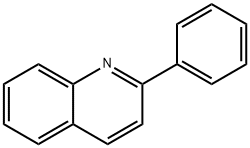
What is 2-Phenylquinoline?
Description
2-Phenylquinoline is the major quinoline alkaloid of Galipea iongiflora, a Bolivian plant used as treatment for cutaneous leishmaniasis. Antinociceptive properties of 2-phenylquinoline isolated from the bark of Galipea iongiflora against different models of pain in mice were evaluated.
Chemical properties
white to light yellow crystalline powder
The Uses of 2-Phenylquinoline
2-Phenylquinoline was used in quantitative structure-activity relationship (QSAR) analyses of estrogen receptor β-selective ligands.
Preparation
Synthesis of 2-phenylquinoline: Quinoline (1.0 g, 7.742 mmol) and phenyl lithium (2.30 mL, 2 M, 23.22 mmol) were reacted according to general procedure. Purification of the residue by silica gel column chromatography (EtOAc:MeOH:Et3N; 10-30:1:1 or PhMe:MeOH:Et3N; 10:1:1) gave 2-phenylquinoline (0.66 g, 42%) as an orange solid.
Aniline (0.140 g, 1.50 mmol) and cinnamaldehyde (0.132 g, 1.00 mmol) were dissolved in toluene in a reaction vial equipped with a magnetic stirrer bar, followed by the addition of K10 (0.50 g). The reaction mixture was heated at a temperature of 110 ?C for 3 hours. After completion of the reaction, the crude product was purified by column chromatography over silica gel eluting with a mixture of Hexane : Ethyl acetate (20:1) to produce 2-Phenylquinoline as a yellow solid (0.044 g, 21%); (m.p. 82-84 ?C) (lit. 84-85 °C); Rf 0.67 (20:1 hexane:ethyl acetate);
1H NMR (400 MHz, CDCl3) δH 7.46-7.51 (1H, m, H-4’), 7.53-7.56 (3H, m, H-6, 3’, 5’), 7.73- 7.77 (1H, m, H-7), 7.85 (1H, d, J = 8.31 Hz, H-5), 7.88-7.91 (1H, d, J = 8.31 Hz, H-3), 8.18- 8.27 (4H, m, H-4, 8, 2’, 6’)
13C NMR(400 MHz, CDCl3) δC 119.2 (C-3), 126.7 (C-6), 127.2 (C-4a), 127.5 (C-2’, 6’), 127.9 (C-5), 128.4 (C-3’, 5’), 128.7 (C-4’), 128.9 (C-7, 8), 129.8 (C-4), 130.3 (C-1’), 137.9 (C-8a), 157.2 (C-2)
Synthesis Reference(s)
Synthetic Communications, 23, p. 1959, 1993 DOI: 10.1080/00397919308009854
Chemical and Pharmaceutical Bulletin, 26, p. 3485, 1978 DOI: 10.1248/cpb.26.3485
Journal of the American Chemical Society, 71, p. 2327, 1949 DOI: 10.1021/ja01175a017
Properties of 2-Phenylquinoline
| Melting point: | 84-85 °C (lit.) |
| Boiling point: | 363 °C |
| Density | 1.1155 (rough estimate) |
| refractive index | 1.6550 (estimate) |
| storage temp. | Sealed in dry,Room Temperature |
| form | Crystalline Powder |
| pka | 4.52±0.10(Predicted) |
| color | White to light yellow |
| Water Solubility | SLIGHTLY SOLUBLE |
| λmax | 258nm(lit.) |
| CAS DataBase Reference | 612-96-4(CAS DataBase Reference) |
| NIST Chemistry Reference | Quinoline, 2-phenyl-(612-96-4) |
Safety information for 2-Phenylquinoline
| Signal word | Warning |
| Pictogram(s) |
 Exclamation Mark Irritant GHS07 |
| GHS Hazard Statements |
H315:Skin corrosion/irritation H319:Serious eye damage/eye irritation H335:Specific target organ toxicity, single exposure;Respiratory tract irritation |
| Precautionary Statement Codes |
P261:Avoid breathing dust/fume/gas/mist/vapours/spray. P264:Wash hands thoroughly after handling. P264:Wash skin thouroughly after handling. P271:Use only outdoors or in a well-ventilated area. P280:Wear protective gloves/protective clothing/eye protection/face protection. P302+P352:IF ON SKIN: wash with plenty of soap and water. P305+P351+P338:IF IN EYES: Rinse cautiously with water for several minutes. Remove contact lenses, if present and easy to do. Continuerinsing. |
Computed Descriptors for 2-Phenylquinoline
New Products
9-Mesityl-10-methylacridinium perchlorate Sulfapyridine Fmoc-OSu (R)-(-)-2-Amino-1-propanol Cyclobutanone 5-bromo-4-fluoro-2-nitrobenzaldehyde 4 pentyn 1 ol N-Vinylformamide Phenethyl cinnamate Pyrrolo[1,2-a]pyrimidine-6-carboxylic acid, 4,6,7,8-tetrahydro-4-oxo-, sodium salt (1:1), (6S) Ethyl 3-phenylpropanoate β-Bromostyrene Methacrylate-PEG-Methacrylate, Mn:35000 2,4-Dihydroxyacetophenone 2-Chloro 5-Fluoro Pyridine Vasicinone 2-Chloroisonicotinic Acid Tween 80 or Polysorbate 80 Methyl trans-4-Aminocyclohexanecarboxylate Hydrochloride N-(4-fluoro-2-methoxy-5-nitrophenyl)-4-(1-methyl-1H-indol-3-yl)pyrimidin-2-amine Pirtobrutinib intd. 4-Nitrobenzotrifluoride 2-Pentyn-1-oL N-(4-Cyano-3-(trifluoromethyl)phenyl)-2-methyloxirane-2-carboxamideRelated products of tetrahydrofuran


You may like
-
 2-Phenylquinoline CAS 612-96-4View Details
612-96-4 -
2-Phenylquinoline CAS 612-96-4View Details
612-96-4 -
Fmoc-OSu 98+View Details
82911-69-1 -
(R)-(-)-2-Amino-1-propanol 35320-23-1 98+View Details
35320-23-1 -
1191-95-3 Cyclobutanone 98+View Details
1191-95-3 -
213382-45-7 98+View Details
213382-45-7 -
Fmoc-OSu 98+View Details
82911-69-1 -
(R)-(-)-2-Amino-1-propanol 35320-23-1 98+View Details
35320-23-1