
2-Nitrodiphenylamine
Synonym(s):2-Nitro-N-phenylaniline
- CAS NO.:119-75-5
- Empirical Formula: C12H10N2O2
- Molecular Weight: 214.22
- MDL number: MFCD00007089
- EINECS: 204-348-6
- SAFETY DATA SHEET (SDS)
- Update Date: 2026-05-28 02:00:54
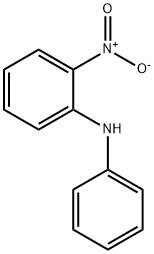
What is 2-Nitrodiphenylamine?
Description
2-Nitrodiphenylamine is a double-base (DB) rocket propellant stabilizer and its microencapsulation potentially improves the shelf life of DB rocket propellants.
Chemical properties
Red Crystalline Solid
The Uses of 2-Nitrodiphenylamine
(2-Nitrophenyl)phenylamine (cas# 119-75-5) is a compound useful in organic synthesis.
The Uses of 2-Nitrodiphenylamine
2-Nitrodiphenylamine is used to control the combustion of propylene glycol dinitrate in Otto fuel II (US navy propellant for torpedoes and other weapons systems); Also used as a solvent dye; Used as stabilizer for nitroglycerin and as a chemical intermediate
General Description
Red-brown crystalline powder or reddish-brown solid.
Air & Water Reactions
2-Nitrodiphenylamine may be sensitive to prolonged exposure to air. Insoluble in water.
Reactivity Profile
2-Nitrodiphenylamine is incompatible with strong oxidizers, strong acids and strong bases.
Health Hazard
Symptoms of exposure to this chemical include irritation of the skin,
eyes, mucous membranes and upper respiratory tract. Structurally similar
chemicals may cause methemoglobinemia.
ACUTE/CHRONIC HAZARDS: This
chemical may be harmful by inhalation or ingestion. When heated to
decomposition it emits toxic fumes of carbon monoxide, carbon dioxide and nitrogen oxides
Fire Hazard
Flash point data for 2-Nitrodiphenylamine are not available; however, 2-Nitrodiphenylamine is probably combustible.
Synthesis
The synthesis of 2-Nitrodiphenylamine is as follows:The mixture of phenylboronic acid (1 mmol), aromatic amine (1.2 mmol) and 0.12 g (2 mmol) of KF in DMSO (4 mL) were added to Cu-IS-AMBA-MNPs (0.06 g, 0.025 mmol) at 130 °C under nitrogen atmosphere for 2 h with vigorous stirring. Then, after completion of the reaction, the catalyst was separated by an external magnet and washed with dry CH2Cl2 three times and checked for its reusability. The solvent of the reaction mixture was evaporated by a rotary evaporator and then ethyl acetate and water were added to the residue. The organic layer was dried over anhydrous MgSO4. The solvent was evaporated under reduced pressure and the crude product was purified by column chromatography using ethyl acetate/n-hexane.
Properties of 2-Nitrodiphenylamine
| Melting point: | 74-76 °C(lit.) |
| Boiling point: | 346 °C |
| Density | 1.36 |
| vapor density | 10.7 (vs air) |
| refractive index | 1.6660 (estimate) |
| Flash point: | 346°C |
| storage temp. | Keep in dark place,Inert atmosphere,Room temperature |
| solubility | Chloroform (Slightly), , DMSO (Slightly), Methanol (Slightly, Sonicated) |
| pka | -3.39±0.20(Predicted) |
| form | Solid |
| color | Red |
| Water Solubility | negligible |
| BRN | 2213591 |
| CAS DataBase Reference | 119-75-5(CAS DataBase Reference) |
| NIST Chemistry Reference | Benzenamine, 2-nitro-N-phenyl-(119-75-5) |
| EPA Substance Registry System | 2-Nitrodiphenylamine (119-75-5) |
Safety information for 2-Nitrodiphenylamine
| Signal word | Warning |
| Pictogram(s) |
 Exclamation Mark Irritant GHS07 |
| GHS Hazard Statements |
H315:Skin corrosion/irritation H319:Serious eye damage/eye irritation H335:Specific target organ toxicity, single exposure;Respiratory tract irritation |
| Precautionary Statement Codes |
P261:Avoid breathing dust/fume/gas/mist/vapours/spray. P305+P351+P338:IF IN EYES: Rinse cautiously with water for several minutes. Remove contact lenses, if present and easy to do. Continuerinsing. |
Computed Descriptors for 2-Nitrodiphenylamine
| InChIKey | RUKISNQKOIKZGT-UHFFFAOYSA-N |
New Products
5-bromo-4-fluoro-2-nitrobenzaldehyde (R)-(-)-2-Amino-1-propanol Cyclobutanone Fmoc-OSu 1-(2-Chloroethyl)pyrrolidine Hydrochloride 2-Amino-2-(4-methylphenyl)acetic acid β-Bromostyrene Ethyl 3-phenylpropanoate Phenethyl cinnamate Dipropyl disulfide 4 pentyn 1 ol N-Vinylformamide Methacrylate-PEG-Methacrylate, Mn:35000 2,4-Dihydroxyacetophenone 2-Chloro 5-Fluoro Pyridine Vasicinone 2-Chloroisonicotinic Acid Tween 80 or Polysorbate 80 2-Butyn-1-oL 2-Pentyn-1-oL 4-Nitrobenzotrifluoride N-(4-fluoro-2-methoxy-5-nitrophenyl)-4-(1-methyl-1H-indol-3-yl)pyrimidin-2-amine Pirtobrutinib intd. N-(4-Cyano-3-(trifluoromethyl)phenyl)-2-methyloxirane-2-carboxamideRelated products of tetrahydrofuran
![1-[2-(Trifluoromethyl)phenyl]hydrazine](https://img.chemicalbook.in/CAS/GIF/365-34-4.gif)
You may like
-
 Nitro DiphenylamineView Details
119-75-5 -
 Fmoc-OSu 98+View Details
82911-69-1 -
7250-67-1 1-(2-Chloroethyl)pyrrolidine Hydrochloride 98+View Details
7250-67-1 -
13227-01-5 98+View Details
13227-01-5 -
7250-67-1 1-(2-Chloroethyl)pyrrolidine Hydrochloride 98+View Details
7250-67-1 -
13227-01-5 98+View Details
13227-01-5 -
7250-67-1 1-(2-Chloroethyl)pyrrolidine Hydrochloride 98+View Details
7250-67-1 -
13227-01-5 98+View Details
13227-01-5