
2-Naphthaldehyde
Synonym(s):β-Naphthaldehyde
- CAS NO.:66-99-9
- Empirical Formula: C11H8O
- Molecular Weight: 156.18
- MDL number: MFCD00004094
- EINECS: 200-640-2
- SAFETY DATA SHEET (SDS)
- Update Date: 2026-05-28 04:40:44
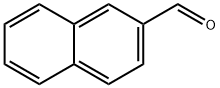
What is 2-Naphthaldehyde?
Chemical properties
Pink crystalline
The Uses of 2-Naphthaldehyde
2-Naphthaldehyde aids in stereo-selective formation of bicyclo 2-siloxy-2-alkoxyoxetanes. It is also used as catalytic agent and petrochemical additive.
The Uses of 2-Naphthaldehyde
2-Naphthaldehyde can be used as a reactant:
- In proline catalyzed aldol reaction.
- In asymmetric three-component Mannich reaction.
- For the synthesis of Hantzsch 1,4-dihydropyridines.13}
- Asymmetric benzoin condensation reaction.
- For the synthesis of pyrazolo[1,2?b]phthalazinediones.
- For the synthesis C60 by flash vacuum pyrolysis.
Definition
ChEBI: A naphthaldehyde that is naphthalene substituted by a formyl group at position 2.
Synthesis Reference(s)
Synthesis, p. 470, 1996 DOI: 10.1055/s-1996-4246
Purification Methods
Distil 2-naphthaldehyde with steam then crystallise it from water or EtOH. [Beilstein 7 IV 1288.]
Properties of 2-Naphthaldehyde
| Melting point: | 58-61 °C (lit.) |
| Boiling point: | 160 °C (19 mmHg) |
| Density | 1.6211 |
| refractive index | 1.6211 (estimate) |
| Flash point: | 160°C/19mm |
| storage temp. | -20°C |
| solubility | Chloroform, Methanol (Sparingly) |
| form | Powder or Chunks |
| color | Off-white to yellow or light beige |
| Water Solubility | Soluble in hot water. |
| FreezingPoint | 1.0755 |
| Sensitive | Air Sensitive |
| BRN | 507750 |
| CAS DataBase Reference | 66-99-9(CAS DataBase Reference) |
| NIST Chemistry Reference | 2-Naphthalenecarboxaldehyde(66-99-9) |
| EPA Substance Registry System | 2-Naphthalenecarboxaldehyde (66-99-9) |
Safety information for 2-Naphthaldehyde
| Signal word | Warning |
| Pictogram(s) |
 Skull and Crossbones Acute Toxicity GHS06  Exclamation Mark Irritant GHS07 |
| GHS Hazard Statements |
H301:Acute toxicity,oral H315:Skin corrosion/irritation H319:Serious eye damage/eye irritation H335:Specific target organ toxicity, single exposure;Respiratory tract irritation |
| Precautionary Statement Codes |
P261:Avoid breathing dust/fume/gas/mist/vapours/spray. P264:Wash hands thoroughly after handling. P264:Wash skin thouroughly after handling. P270:Do not eat, drink or smoke when using this product. P271:Use only outdoors or in a well-ventilated area. P280:Wear protective gloves/protective clothing/eye protection/face protection. P305+P351+P338:IF IN EYES: Rinse cautiously with water for several minutes. Remove contact lenses, if present and easy to do. Continuerinsing. P405:Store locked up. P501:Dispose of contents/container to..… |
Computed Descriptors for 2-Naphthaldehyde
| InChIKey | PJKVFARRVXDXAD-UHFFFAOYSA-N |
New Products
2-Amino-5-bromo-4-(trifluoromethyl)pyridine Sulfapyridine Fmoc-OSu (R)-(-)-2-Amino-1-propanol Cyclobutanone 5-bromo-4-fluoro-2-nitrobenzaldehyde β-Bromostyrene Ethyl 3-phenylpropanoate Phenethyl cinnamate Dipropyl disulfide N-Vinylformamide 4 pentyn 1 ol Methacrylate-PEG-Methacrylate, Mn:35000 2,4-Dihydroxyacetophenone 2-Chloro 5-Fluoro Pyridine Vasicinone 2-Chloroisonicotinic Acid Tween 80 or Polysorbate 80 2-Butyn-1-oL 2-Pentyn-1-oL 4-Nitrobenzotrifluoride N-(4-fluoro-2-methoxy-5-nitrophenyl)-4-(1-methyl-1H-indol-3-yl)pyrimidin-2-amine Pirtobrutinib intd. N-(4-Cyano-3-(trifluoromethyl)phenyl)-2-methyloxirane-2-carboxamideRelated products of tetrahydrofuran
You may like
-
 2-Naphthaldehyde CAS 66-99-9View Details
66-99-9 -
2-Naphthaldehyde, 98% CAS 66-99-9View Details
66-99-9 -
2-Naphthaldehyde CAS 66-99-9View Details
66-99-9 -
 Powder B-Naphthaldehyde CAS No66-99-9, For Industrial, Packaging Type: CarboyView Details
66-99-9 -
1191-95-3 Cyclobutanone 98+View Details
1191-95-3 -
213382-45-7 98+View Details
213382-45-7 -
Fmoc-OSu 98+View Details
82911-69-1 -
(R)-(-)-2-Amino-1-propanol 35320-23-1 98+View Details
35320-23-1
Statement: All products displayed on this website are only used for non medical purposes such as industrial applications or scientific research, and cannot be used for clinical diagnosis or treatment of humans or animals. They are not medicinal or edible.