
2-METHYL-4-PENTENOIC ACID
- CAS NO.:1575-74-2
- Empirical Formula: C6H10O2
- Molecular Weight: 114.14
- MDL number: MFCD00015570
- EINECS: 216-404-7
- SAFETY DATA SHEET (SDS)
- Update Date: 2026-05-27 23:59:19
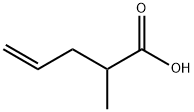
What is 2-METHYL-4-PENTENOIC ACID?
Chemical properties
clear colorless to light yellow liquid
Chemical properties
2-Methyl-4-pentenoic acid has a cheese-like odor.
The Uses of 2-METHYL-4-PENTENOIC ACID
2-Methyl-4-pentenoic acid is used as raw material for fruit flavor or it is an enhancer of fruity fragrances.
Definition
ChEBI: 2-Methyl-4-pentenoic acid is a branched-chain fatty acid.
Synthesis Reference(s)
Chemistry Letters, 9, p. 571, 1980
Tetrahedron Letters, 21, p. 2181, 1980 DOI: 10.1016/S0040-4039(00)78992-1
Properties of 2-METHYL-4-PENTENOIC ACID
| Melting point: | 17.3°C (estimate) |
| Boiling point: | 195 °C(lit.) |
| Density | 0.949 g/mL at 25 °C(lit.) |
| refractive index | n |
| FEMA | 3511 | 2-METHYL-4-PENTENOIC ACID |
| Flash point: | 210 °F |
| storage temp. | Inert atmosphere,Room Temperature |
| solubility | Chloroform (Slightly), Methanol (Slightly) |
| pka | 4.67±0.10(Predicted) |
| form | clear liquid |
| color | Colorless to Red to Green |
| Odor | at 10.00 % in propylene glycol. fruity cheese |
| Water Solubility | Slightly soluble in water |
| JECFA Number | 355 |
| BRN | 1720987 |
| CAS DataBase Reference | 1575-74-2(CAS DataBase Reference) |
| EPA Substance Registry System | 4-Pentenoic acid, 2-methyl- (1575-74-2) |
Safety information for 2-METHYL-4-PENTENOIC ACID
| Signal word | Danger |
| Pictogram(s) |
 Corrosion Corrosives GHS05  Exclamation Mark Irritant GHS07 |
| GHS Hazard Statements |
H290:Corrosive to Metals H302:Acute toxicity,oral H314:Skin corrosion/irritation H318:Serious eye damage/eye irritation |
| Precautionary Statement Codes |
P234:Keep only in original container. P260:Do not breathe dust/fume/gas/mist/vapours/spray. P264:Wash hands thoroughly after handling. P264:Wash skin thouroughly after handling. P280:Wear protective gloves/protective clothing/eye protection/face protection. P310:Immediately call a POISON CENTER or doctor/physician. P390:Absorb spillage to prevent material damage. P301+P330+P331:IF SWALLOWED: Rinse mouth. Do NOT induce vomiting. P303+P361+P353:IF ON SKIN (or hair): Remove/Take off Immediately all contaminated clothing. Rinse SKIN with water/shower. P305+P351+P338:IF IN EYES: Rinse cautiously with water for several minutes. Remove contact lenses, if present and easy to do. Continuerinsing. P405:Store locked up. P406:Store in corrosive resistant/… container with a resistant inner liner. P501:Dispose of contents/container to..… |
Computed Descriptors for 2-METHYL-4-PENTENOIC ACID
| InChIKey | HVRZYSHVZOELOH-UHFFFAOYSA-N |
New Products
N-Carbethoxy-4-piperidone 1-Aminocyclopentane carbonitrile Tetrabutylammonium perchlorate N,O-Dimethylhydroxylamine hydrochloride (RS)-beta-Amino-beta-(4-bromophenyl)propionic acid 2-Amino-5-bromo-4-(trifluoromethyl)pyridine N-Vinylformamide 4 pentyn 1 ol Phenethyl cinnamate Dipropyl disulfide Ethyl 3-phenylpropanoate β-Bromostyrene Methacrylate-PEG-Methacrylate, Mn:35000 2,4-Dihydroxyacetophenone 2-Chloro 5-Fluoro Pyridine Vasicinone 2-Chloroisonicotinic Acid Tween 80 or Polysorbate 80 5-Bromo-1-Pentyne 1-(2-Methyl-5-nitrophenyl)guanidine Nitrate Methyl trans-4-Aminocyclohexanecarboxylate Hydrochloride N-(4-Cyano-3-(trifluoromethyl)phenyl)-2-methyloxirane-2-carboxamide 2-Pentyn-1-oL 4-NitrobenzotrifluorideRelated products of tetrahydrofuran


You may like
-
 2-Methyl-4-pentenoic Acid CAS 1575-74-2View Details
1575-74-2 -
144-83-2 Sulfapyridine 98+View Details
144-83-2 -
29976-53-2 98+View Details
29976-53-2 -
(RS)-beta-Amino-beta-(4-bromophenyl)propionic acid 39773-47-2 98+View Details
39773-47-2 -
6638-79-5 N,O-Dimethylhydroxylamine hydrochloride 98+View Details
6638-79-5 -
674783-97-2 98+View Details
674783-97-2 -
1-Aminocyclopentane carbonitrile 98+View Details
49830-37-7 -
Tetrabutylammonium perchlorate 1923-70-2 98+View Details
1923-70-2
Statement: All products displayed on this website are only used for non medical purposes such as industrial applications or scientific research, and cannot be used for clinical diagnosis or treatment of humans or animals. They are not medicinal or edible.