
2-HEXANOL
Synonym(s):(±)-2-Hexanol;Butyl methyl carbinol
- CAS NO.:626-93-7
- Empirical Formula: C6H14O
- Molecular Weight: 102.17
- MDL number: MFCD00004585
- EINECS: 210-971-4
- SAFETY DATA SHEET (SDS)
- Update Date: 2026-05-28 01:17:54
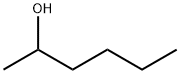
What is 2-HEXANOL?
Chemical properties
colourless liquid
Occurrence
Found among the constituents of several essential oils and aromas, notably apple, strawberry, tea, violet , Java citronella. Bourbon geranium, lavender, lavandin, spike, Litsea zeylanica; also identified in bitter orange . Preparation: By reduction of ethyl caproate with sodium alcoholate or by any other suitable means.
The Uses of 2-HEXANOL
(+/-)-2-Hexanol is s an important raw material and intermediate used in Organic Synthesis, Pharmaceuticals, Agrochemicals and Dyestuff field. It is used as perfuming agent.
Definition
ChEBI: Hexan-2-ol is a hexanol in which the hydroxy group is at position 2. It has a role as a semiochemical, a plant metabolite and a human metabolite. It is a secondary alcohol and a hexanol.
Synthesis Reference(s)
Journal of the American Chemical Society, 89, p. 1522, 1967 DOI: 10.1021/ja00982a043
Toxicity evaluation
The acute oral LD50 in mice was reported as 4 g/kg and in rats as 4.87 g/kg and 4.59 g/kg . The acute dermal LD50 in rabbits was reported as 3.1 ml/kg and as > 5 g/kg . The maximum period of survival of rats inhaling the saturated vapours of hexanol was reported as 8 hr . Gerarde & Ahlstrom found that aspiration of 0-2 ml alcohol C-6 caused respiratory arrest and instant death. Scala & Burtis studied the acute toxicity of commercial grade hexanol by several routes of administration in various species. The acute oral LD50 in rats was 3.67 g/kg and the acute dermal LD50 in rabbits was >2.6 g/kg. Dermal application resulted in signs of CNS toxicity. Inhalation exposure of mice, rats and guineapigs to atmospheres nearly saturated with the hexanol preparation for 6 hr elicited a questionable effect on CNS activity, moderate (but reversible) local irritation mainly involving the mucous membranes and slight lung congestion.
General Description
2-Hexanol is one of the constituent of Porella arboris-vitae extracts which has been determined by solid phase microextraction, gas chromatography-mass spectrometry (SPME GC-MS).
Metabolism
n-Hexanol is metabolized by direct conjugation with glucuronic acid and by oxidation to the carboxylic acid and eventually to CO2. In the rabbit, direct conjugation is a minor pathway and oxidation the major pathway
Properties of 2-HEXANOL
| Melting point: | -23 °C |
| Boiling point: | 136 °C (lit.) |
| Density | 0.814 g/mL at 20 °C
0.81 g/mL at 25 °C (lit.) |
| refractive index | n |
| Flash point: | 115 °F |
| storage temp. | Flammables area |
| form | Liquid |
| pka | 15.31±0.20(Predicted) |
| color | Clear colorless |
| Odor | at 1.00 % in dipropylene glycol. chemical winey fruity fatty terpenic cauliflower |
| Water Solubility | Soluble in water (13 g/L at 25°C), |
| BRN | 1718996 |
| Stability: | Stable. Combustible. Incompatible with strong oxidizing agents. Mixtures with air may be explosive. |
| CAS DataBase Reference | 626-93-7(CAS DataBase Reference) |
| EPA Substance Registry System | 2-Hexanol (626-93-7) |
Safety information for 2-HEXANOL
| Signal word | Warning |
| Pictogram(s) |
 Flame Flammables GHS02 |
| GHS Hazard Statements |
H226:Flammable liquids |
| Precautionary Statement Codes |
P210:Keep away from heat/sparks/open flames/hot surfaces. — No smoking. |
Computed Descriptors for 2-HEXANOL
| InChIKey | QNVRIHYSUZMSGM-UHFFFAOYSA-N |
New Products
2-Bromo-4-hydroxypyridine Dibenzoyl-L-tartaric acid Anhydrous (Resolution Reagent) Dibenzo[b,f][1,4]thiazepin-11(10H)-one 1,2,3,9-Tetrahydro-9-Methyl-4H-Carbazole-4-One Cis-Tosylate 1-(4-methoxyphenyl)-4-(4-Nitrophenyl)Piperazine (IT-1) 1-aminocyclobutanecarbonitrile hydrochloride AMINO-O-TOLYL-ACETIC ACID 1-Aminocyclobutanecarboxylic Acid Hydrochloride AMINO(2-BROMOPHENYL)ACETIC ACID 6-BROMOTETRAZOLO[1,5-A]PYRIDINE 3-Oxocyclobutanecarboxylic acid METHANOL-D1(OD) TERTIARY BUTANOL-D9 N-ETHYL-D5-AMINE HYDROCHLORIDE BENZOIC ACID-D CHLOROFORM-D TOLUENE-D3 2-(2-Bromophenyl)ethanol Boc-D-Glu(OMe)-OMe 2,5 Dibromopyridine Ethyl 4-hydroxy-3-oxobutanoate Dimethyl (2S)-2-((tert-butoxycarbonyl)amino)-4-(cyanomethyl)pentanedioate 1-(3-Chlorophenyl)piperazine hydrochlorideRelated products of tetrahydrofuran



You may like
-
 (+/-)-2-Hexanol CAS 626-93-7View Details
626-93-7 -
2-Hexanol CAS 626-93-7View Details
626-93-7 -
2-Hexanol CAS 626-93-7View Details
626-93-7 -
254762-66-8 AMINO(2-BROMOPHENYL)ACETIC ACID 98+View Details
254762-66-8 -
6-BROMOTETRAZOLO[1,5-A]PYRIDINE 98+View Details
5799-75-7 -
254762-66-8 AMINO(2-BROMOPHENYL)ACETIC ACID 98+View Details
254762-66-8 -
23716-23-1 98+View Details
23716-23-1 -
6-BROMOTETRAZOLO[1,5-A]PYRIDINE 98+View Details
5799-75-7