
2-fdck / 2-fluorodeschloroketamine
- CAS NO.:111982-50-4
- Empirical Formula: C13H16FNO
- Molecular Weight: 221.27
- EINECS: 200-001-8
- SAFETY DATA SHEET (SDS)
- Update Date: 2023-02-15 13:25:28
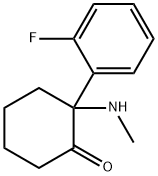
What is 2-fdck / 2-fluorodeschloroketamine?
History
The synthesis of 2-FDCK was first described in a 2013 paper as part of a larger effort to synthesize and evaluate new anesthetic drugs based on ketamine and its analogues. Ketamine itself was first introduced in 1964 and was approved for clinical use in 1970. Since then it has become one of the most important and applicable general anesthetics as well as a popular recreational drug.
The use of 2-FDCK as a designer drug has been reported in various countries. Many of these new psychoactive substances (NPS) appear on the drug market in order to circumvent existing drug policies. 2-FDCK was first formally notified by the EMCDDA in 2016, alongside 65 other new substances. Due to its recent appearance, little research has been done on the compound so far.
The Uses of 2-fdck / 2-fluorodeschloroketamine
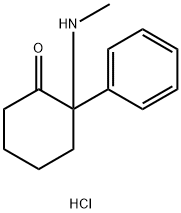
2-(2-Fluorophenyl)-2-(methylamino)-cyclohexanone is a related compound of Ketamine (K165300), an anesthetic.
The Uses of 2-fdck / 2-fluorodeschloroketamine
2-Fluorodeschloroketamine (also known as 2'-Fl-2-Oxo-PCM, Fluoroketamine and 2-FDCK) is a dissociative anesthetic related to ketamine. Its sale and use as a designer drug has been reported in various countries. It is an analogue of ketamine where the chlorine group has been replaced by fluorine. Due to its recent emergence, the pharmocological specifics of the compound are mostly unclear.
Pharmacokinetics
2-FDCK is structurally similar to ketamine, so a similar mechanism of action is expected, but there has been no study done to confirm this. Due to the halogen in the 2 position not being a chlorine but a fluorine, the molecule is less polar. This could influence binding to proteins, such as the NMDA receptor that ketamine primarily binds to and acts as an antagonist towards.
Properties of 2-fdck / 2-fluorodeschloroketamine
| Boiling point: | 333.6±42.0 °C(Predicted) |
| Density | 1.12±0.1 g/cm3(Predicted) |
| pka | 6.51±0.20(Predicted) |
Safety information for 2-fdck / 2-fluorodeschloroketamine
Computed Descriptors for 2-fdck / 2-fluorodeschloroketamine
New Products
5-bromo-4-fluoro-2-nitrobenzaldehyde (R)-(-)-2-Amino-1-propanol Cyclobutanone Fmoc-OSu 1-(2-Chloroethyl)pyrrolidine Hydrochloride 2-Amino-2-(4-methylphenyl)acetic acid β-Bromostyrene Ethyl 3-phenylpropanoate Phenethyl cinnamate Dipropyl disulfide 4 pentyn 1 ol N-Vinylformamide Methacrylate-PEG-Methacrylate, Mn:35000 2,4-Dihydroxyacetophenone 2-Chloro 5-Fluoro Pyridine Vasicinone 2-Chloroisonicotinic Acid Tween 80 or Polysorbate 80 2-Butyn-1-oL 2-Pentyn-1-oL 4-Nitrobenzotrifluoride N-(4-fluoro-2-methoxy-5-nitrophenyl)-4-(1-methyl-1H-indol-3-yl)pyrimidin-2-amine Pirtobrutinib intd. N-(4-Cyano-3-(trifluoromethyl)phenyl)-2-methyloxirane-2-carboxamideRelated products of tetrahydrofuran
You may like
-
 Fmoc-OSu 98+View Details
82911-69-1 -
(R)-(-)-2-Amino-1-propanol 35320-23-1 98+View Details
35320-23-1 -
7250-67-1 1-(2-Chloroethyl)pyrrolidine Hydrochloride 98+View Details
7250-67-1 -
13227-01-5 98+View Details
13227-01-5 -
7250-67-1 1-(2-Chloroethyl)pyrrolidine Hydrochloride 98+View Details
7250-67-1 -
13227-01-5 98+View Details
13227-01-5 -
7250-67-1 1-(2-Chloroethyl)pyrrolidine Hydrochloride 98+View Details
7250-67-1 -
13227-01-5 98+View Details
13227-01-5