
2-(4-Aminophenylthio)acetic acid
Synonym(s):S-(4-Aminophenyl)thioglycolic acid
- CAS NO.:104-18-7
- Empirical Formula: C8H9NO2S
- Molecular Weight: 183.23
- MDL number: MFCD00025360
- EINECS: 203-182-1
- SAFETY DATA SHEET (SDS)
- Update Date: 2026-09-12 18:56:28
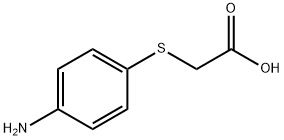
What is 2-(4-Aminophenylthio)acetic acid?
Chemical properties
light khaki crystalline powder
The Uses of 2-(4-Aminophenylthio)acetic acid
2-(4-Aminophenylthio)acetic Acid is a useful reagent for preparing visible light-sensitive photochromic azobenzene compounds.
The Uses of 2-(4-Aminophenylthio)acetic acid
Synthetic intermediate for dyes and pharmaceuticals.
The Uses of 2-(4-Aminophenylthio)acetic acid
It can react with 2-phenyl-benzo[d][1,3]oxazin-4-one to get 2-(Phenyl-4-(3H)-quinazolyl)-phenyl-4'-mercaptoacetic acid. This reaction needs solvents pyridine and H2O by heating.
Properties of 2-(4-Aminophenylthio)acetic acid
| Melting point: | 197-203 °C |
| Boiling point: | 405.3±25.0 °C(Predicted) |
| Density | 1.35±0.1 g/cm3(Predicted) |
| storage temp. | -20°C Freezer |
| solubility | Soluble in methanol, acetone, toluene, n-octanol, acetonitrile, ethyl acetate, dichloromethane. |
| pka | 3.21±0.10(Predicted) |
| form | Solid |
| color | Off-White to Pale Beige |
| BRN | 2720454 |
| CAS DataBase Reference | 104-18-7(CAS DataBase Reference) |
Safety information for 2-(4-Aminophenylthio)acetic acid
| Signal word | Danger |
| Pictogram(s) |
 Skull and Crossbones Acute Toxicity GHS06  Exclamation Mark Irritant GHS07  Health Hazard GHS08 |
| GHS Hazard Statements |
H301:Acute toxicity,oral H302:Acute toxicity,oral H315:Skin corrosion/irritation H319:Serious eye damage/eye irritation H334:Sensitisation, respiratory H335:Specific target organ toxicity, single exposure;Respiratory tract irritation |
| Precautionary Statement Codes |
P261:Avoid breathing dust/fume/gas/mist/vapours/spray. P301+P310:IF SWALLOWED: Immediately call a POISON CENTER or doctor/physician. P304+P340:IF INHALED: Remove victim to fresh air and Keep at rest in a position comfortable for breathing. P305+P351+P338:IF IN EYES: Rinse cautiously with water for several minutes. Remove contact lenses, if present and easy to do. Continuerinsing. P342+P311:IF experiencing respiratory symptoms: call a POISON CENTER or doctor/physician. P405:Store locked up. |
Computed Descriptors for 2-(4-Aminophenylthio)acetic acid
2-(4-Aminophenylthio)acetic acid manufacturer
New Products
2-(2-Chlorophenyl)glycine Propiolic Acid 1-(3-Hydroxy-4-methoxyphenyl)-2-nitroethene (±)-amino(2-fluorophenyl)acetic acid trans-3-Benzyloxy-4-methoxy-beta-nitrostyrene 1-Pentadecanol 4-(4-Αminophenyl)-3-Morpholinone 3-Morpholino-1-(4-(2-oxopiperidin-1-yl) phenyl)-5,6-dihyropyridin-2-(1H)-one 1-(4-Aminophenyl)-3-morpholino-5,6-dihydropyridin-2(1H)-one N-cyanoacetylurethane 1H-IndazoleRelated products of tetrahydrofuran
![ethyl 2-[(4-acetamidophenyl)sulfanyl]acetate](https://img.chemicalbook.in/CAS/20200401/GIF/CB71790594.gif)

![2-[(4-NITROPHENYL)THIO]PROPANOIC ACID](https://img.chemicalbook.in/StructureFile/ChemBookStructure8/GIF/CB3695401.gif)
![[(4-NITROPHENYL)SULFONYL]ACETIC ACID](https://img.chemicalbook.in/StructureFile/ChemBookStructure7/GIF/CB0331427.gif)

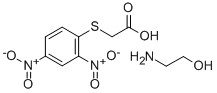

![[(2,4-DINITROPHENYL)SULFONYL]ACETIC ACID](https://img.chemicalbook.in/StructureFile/ChemBookStructure5/GIF/CB8165402.gif)
You may like
-
 104-18-7 97-99 %View Details
104-18-7 -
471-25-0 Propiolic Acid 98+View Details
471-25-0 -
84145-28-8 98+View Details
84145-28-8 -
trans-3-Benzyloxy-4-methoxy-beta-nitrostyrene 98+View Details
63909-29-5 -
2-(2-Chlorophenyl)glycine 88744-36-9 98+View Details
88744-36-9 -
40216-83-9 trans-4-Hydroxy-L-proline methyl ester hydrochloride 98+View Details
40216-83-9 -
629-76-5 98+View Details
629-76-5 -
1-(3-Hydroxy-4-methoxyphenyl)-2-nitroethene 98+View Details
39816-35-8
Statement: All products displayed on this website are only used for non medical purposes such as industrial applications or scientific research, and cannot be used for clinical diagnosis or treatment of humans or animals. They are not medicinal or edible.