
1,4-Dinitrobenzene
- CAS NO.:100-25-4
- Empirical Formula: C6H4N2O4
- Molecular Weight: 168.11
- MDL number: MFCD00007314
- EINECS: 202-833-7
- SAFETY DATA SHEET (SDS)
- Update Date: 2026-09-12 18:51:43
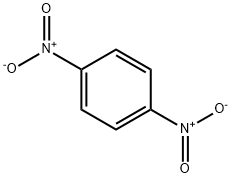
What is 1,4-Dinitrobenzene?
Chemical properties
light yellow powder
Physical properties
Clear, colorless to white crystalline solid or monoclinic crystals. Slowly turns yellow on exposure to air.
The Uses of 1,4-Dinitrobenzene
1,4-Dinitrobenzene is used in a study to evaluate the ionization mechanism and solvent effect by novel atmospheric pressure photoionization mass spectrometry in negative ion mode for analysis of some compounds. 1,4-Dinitrobenzene can be used in synthesis of dyes and dye intermediates.
The Uses of 1,4-Dinitrobenzene
manufacture of dyes, dye intermediates, explosives, plastics.
Definition
ChEBI: A dinitrobenzene carrying nitro groups at positions 1 and 4.
General Description
Colorless to yellow solid. Sinks and mixes slowly with water.
Air & Water Reactions
Slowly mixes with water.
Reactivity Profile
All three isomers have similar properties and may react vigorously with oxidizing materials. Their reaction with nitric acid (nitration) will lead to a mixture of trinitrobenzenes possessing high-explosive properties [Urbanski, 1967, vol. 3, p. 290]. If heat and reaction conditions of the nitration are not controlled, detonation comparable to TNT may occur [Anon., J. R. Inst. Chem., 1960, 84, p. 451]. Mixture of 1,3-dinitrobenzene with tetranitromethane was found highly explosive [Urbanski, 1964, vol. 1, 592]. 1,2-dinitrobenzene is a severe explosion hazard when shocked or exposed to heat or flame. When heated to decomposition all dinitrobenzens emit toxic fumes of nitrogen oxides [Sax, 9th ed., 1996, p. 1374].
Health Hazard
INHALATION OR INGESTION: Headache, vertigo, nausea, vomiting, diarrhea, fever, rapid weak pulse, decreased blood pressure, cyanosis, exhaustion, hepatomegaly, jaundice, albuminurea, hematuria, visual scotomata, amblyopia and nystagmus. EYES: Irritation. SKIN: Stains skin yellow; if skin contact is prolonged, can be absorbed into blood causing same symptoms as for inhalation.
Safety Profile
Suspected carcinogen. Poison by ingestion. Mutation data reported. Mxture with nitric acid is a high explosive. When heated to decomposition it emits toxic fumes of NOx. See also 0and mDINITROBENZENE
Environmental Fate
Biological. In activated sludge inoculum, following a 20-d adaptation period, no biodegradation
was observed (Pitter, 1976).
Photolytic. Low et al. (1991) reported that the nitro-containing compounds (e.g., 2,4-
dinitrophenol) undergo degradation by UV light in the presence of titanium dioxide yielding
ammonium, carbonate, and nitrate ions. By analogy, 1,4-dinitrobenzene should degrade forming
identical ions.
Chemical/Physical. Releases toxic nitrogen oxides when heated to decomposition (Sax and
Lewis, 1987). 1,4-Dinitrobenzene will not hydrolyze in water (Kollig, 1993).
Purification Methods
Crystallise 1,4-dinitrobenzene from EtOH or EtOAc. Dry it under vacuum over P2O5. It can be sublimed in a vacuum. [Beilstein 5 IV 741.]
Properties of 1,4-Dinitrobenzene
| Melting point: | 170-173 °C(lit.) |
| Boiling point: | 183.4 °C34 mm Hg(lit.) |
| Density | 1.625 g/mL at 25 °C(lit.) |
| vapor pressure | 2.25 x 10⁻⁴ mmHg at 35 °C (Hine et al., 1963) |
| refractive index | 1.725 (589.3 nm) |
| Flash point: | 150 °C |
| storage temp. | Store below +30°C. |
| solubility | alcohol: soluble1g in 300ml |
| form | Crystals or Powder |
| color | Ochre to orange |
| Water Solubility | Soluble in water. (0.8 g/L) at 20°C. |
| Merck | 14,3273 |
| BRN | 1105828 |
| Henry's Law Constant | 4.79(x 10-7 atm?m3/mol) at 35 °C (approximate - calculated from water solubility and vapor pressure) |
| Exposure limits | NIOSH REL: TWA 1, IDLH 50; OSHA PEL: TWA 1 ACGIH TLV:
TWA 0.15 ppm for all isomers (adopted). |
| Stability: | Stable, but may be shock-sensitive. May explode if heated. Incompatible with oxidizing agents, strong bases, nitric acid, many metals, tin oxides. |
| CAS DataBase Reference | 100-25-4(CAS DataBase Reference) |
| EPA Substance Registry System | p-Dinitrobenzene (100-25-4) |
Safety information for 1,4-Dinitrobenzene
| Signal word | Danger |
| Pictogram(s) |
 Skull and Crossbones Acute Toxicity GHS06  Health Hazard GHS08  Environment GHS09 |
| GHS Hazard Statements |
H373:Specific target organ toxicity, repeated exposure H410:Hazardous to the aquatic environment, long-term hazard |
| Precautionary Statement Codes |
P262:Do not get in eyes, on skin, or on clothing. P264:Wash hands thoroughly after handling. P264:Wash skin thouroughly after handling. P273:Avoid release to the environment. P280:Wear protective gloves/protective clothing/eye protection/face protection. |
Computed Descriptors for 1,4-Dinitrobenzene
New Products
5-bromo-4-fluoro-2-nitrobenzaldehyde (R)-(-)-2-Amino-1-propanol Cyclobutanone Fmoc-OSu 1-(2-Chloroethyl)pyrrolidine Hydrochloride 2-Amino-2-(4-methylphenyl)acetic acid Obidoxime hydrochloride API Decanoic acid, 2-[4-(phenylmethoxy)phenyl]ethyl ester Piperazine, 1-(3-methoxyphenyl)-, hydrochloride (1:1) 4-Bromo-2,6-difluoroaniline 4 pentyn 1 ol N-Vinylformamide Methacrylate-PEG-Methacrylate, Mn:35000 2,4-Dihydroxyacetophenone 2-Chloro 5-Fluoro Pyridine Vasicinone 2-Chloroisonicotinic Acid Tween 80 or Polysorbate 80 2-Pentyn-1-oL 4-Nitrobenzotrifluoride N-(4-Cyano-3-(trifluoromethyl)phenyl)-2-methyloxirane-2-carboxamide N-(4-fluoro-2-methoxy-5-nitrophenyl)-4-(1-methyl-1H-indol-3-yl)pyrimidin-2-amine Pirtobrutinib intd. 2-Butyn-1-oLRelated products of tetrahydrofuran



You may like
-
 1,4-Dinitrobenzene CAS 100-25-4View Details
100-25-4 -
1,4-Dinitrobenzene CAS 100-25-4View Details
100-25-4 -
7250-67-1 1-(2-Chloroethyl)pyrrolidine Hydrochloride 98+View Details
7250-67-1 -
13227-01-5 98+View Details
13227-01-5 -
7250-67-1 1-(2-Chloroethyl)pyrrolidine Hydrochloride 98+View Details
7250-67-1 -
13227-01-5 98+View Details
13227-01-5 -
7250-67-1 1-(2-Chloroethyl)pyrrolidine Hydrochloride 98+View Details
7250-67-1 -
13227-01-5 98+View Details
13227-01-5