
(-)-FENCHONE
Synonym(s):(−)-1,3,3-Trimethyl-2-norbornanone;(−)-Fenchone;(1R)-(−)-Fenchone;(1R)-1,3,3-Trimethylbicyclo[2.2.1]heptan-2-one;(1R)-1,3,3-Trimethylbicyclo[2.2.1]heptan-2-one
- CAS NO.:7787-20-4
- Empirical Formula: C10H16O
- Molecular Weight: 152.23
- MDL number: MFCD00151104
- EINECS: 232-107-5
- SAFETY DATA SHEET (SDS)
- Update Date: 2026-05-28 00:05:14
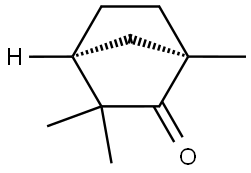
What is (-)-FENCHONE?
Chemical properties
CLEAR COLOURLESS TO SLIGHTLY YELLOW LIQUID
Occurrence
Reported to be found in many essential oils, including those of Thuja plicata, T.occiden-talis, T.standi shii, Russian anise, fennel, a few Artemisia varieties (A. frigida, A . verlotorum and A . santolinaefolia), Lavandula stoechas and L. burmannii. The highest levels (12-19%) are found in fennel oil (Fenarolis Handbook of Flavor Ingredients, 1975; Gildemeister & Hoffman, 1963).
The Uses of (-)-FENCHONE
(1R,?4S)?-1,?3,?3-?Trimethylbicyclo[2.2.1]?heptan-?2-?one also known more commonly as (-)-Fenchone is a chiral intermediate of Fenchone and is currently being used for studies ranging from inhibitory effects of monoterpenes on human TRPA1 and odorant receptor of the malaria vector Anopheles gambiae.
The Uses of (-)-FENCHONE
Flavoring.
Definition
ChEBI: A fenchone that has (1R,4S)-stereochemistry. It is a constituent of the essential oils obtained from fennel.
Preparation
By isolation from cedar leaf oil (Thuja oil) or by various synthetic methods (Arctander, 1969).
General Description
(1R)-(-)-Fenchone is a bridged bicyclic ketone found in fennel oil and thuja oil.
Flammability and Explosibility
Not classified
Pharmacology
In mice, fenchone injected sc in sesame oil produced clonic convulsions at non-lethal doses, with a median convulsive dose (CD50) of 1133 mg/kg, and a dose of 500 mg/kg given sc was an effective arousal agent, reducing the hexobarbitone sleep time (Wenzel & Ross, 1957). In rats, an ip dose of 500 mg/kg had no effect on pentobarbitone-depressed respiration, while ip doses of 50-400 mg/kg increased running activity but did not affect total activity (Wenzel & Ross, 1957). Fenchone showed some antispasmodic action on excised mouse intestine (Haginiwa, Harada & Morishita, 1963), and at 260 mmol/kg showed good choleretic properties of moderately long duration when given orally in olive oil to rats (M?rsdorf, 1966). Thomas (1958) reported that it acted as a central nervous system stimulant. Fenchone has been used medically as a counter-irritant (Merck Index, 1968).
Metabolism
Rimini (1901 & 1909) showed that, in the dog, fenchone was probably oxidized to 4-hydroxyfenchone. Reinartz & Zanke (1936) showed that there were other products. They separated, as lead salts, the glucuronides from the urine of dogs receiving d-fenchone. The lead was removed with sulphuric acid and the resulting solution was hydrolysed. In the resulting mixture of hydroxyfen chones, the presence of 4- and 5-hydroxyfenchones and 7r-apofenchone-3-carboxylic acid was demon strated (Williams, 1959).
Purification Methods
Purification is as for the (+)-enantiomer above and should have the same physical properties except for opposite optical rotations. UV has max 285nm ( 12.29). [Braun & Jacob Chem Ber 66 1461 1933, UV: Ohloff et al. Chem Ber 90 106 1957.] [Beilstein 7 III 392, 7 IV 212.]
Properties of (-)-FENCHONE
| Melting point: | 5-6 °C(lit.) |
| Boiling point: | 192-194 °C(lit.) |
| alpha | [α]D20 -50~-60° (c=4, C2H5OH) |
| Density | 0.948 g/mL at 25 °C(lit.) |
| vapor pressure | 2.149hPa at 20℃ |
| refractive index | n |
| FEMA | 4519 | L-FENCHONE |
| Flash point: | 127 °F |
| storage temp. | 2-8°C |
| solubility | Chloroform (Slightly), Ethanol (Slightly, Sonicated) |
| form | Liquid |
| color | Clear colorless to light yellow |
| Odor | at 100.00 %. camphor herbal earthy woody |
| optical activity | [α]24/D 50.5°, neat |
| Water Solubility | 1.983g/L at 20℃ |
| JECFA Number | 2200 |
| BRN | 2042710 |
| Dielectric constant | 12.0(20℃) |
| CAS DataBase Reference | 7787-20-4(CAS DataBase Reference) |
| EPA Substance Registry System | Bicyclo[2.2.1]heptan-2-one, 1,3,3-trimethyl-, (1R,4S)- (7787-20-4) |
Safety information for (-)-FENCHONE
| Signal word | Warning |
| Pictogram(s) |
 Environment GHS09 |
| GHS Hazard Statements |
H411:Hazardous to the aquatic environment, long-term hazard |
| Precautionary Statement Codes |
P273:Avoid release to the environment. P391:Collect spillage. Hazardous to the aquatic environment P501:Dispose of contents/container to..… |
Computed Descriptors for (-)-FENCHONE
New Products
Dibenzoyl-L-tartaric acid Anhydrous (Resolution Reagent) Cis-Tosylate Dibenzo[b,f][1,4]thiazepin-11(10H)-one 1,2,3,9-Tetrahydro-9-Methyl-4H-Carbazole-4-One 1-(4-methoxyphenyl)-4-(4-Nitrophenyl)Piperazine (IT-1) BOC Piperazine 1-Benzhydrylazetane-3-carbonitrile 8-oxa-1,3-diazaspiro[4.5]decane-2,4-dione (±)-amino(2-fluorophenyl)acetic acid 2-(2-Chlorophenyl)glycine AMINO-(3-CHLORO-PHENYL)-ACETIC ACID 2'-Fluoroacetophenone METHANOL-D1(OD) TERTIARY BUTANOL-D9 N-ETHYL-D5-AMINE HYDROCHLORIDE BENZOIC ACID-D CHLOROFORM-D TOLUENE-D3 Trans,trans muconic acid HC Blue-16 4-Amino-2-chloro-6,7-dimethoxyquinazoline Ethyl 4,5-bis(2-methoxyethoxy)-2-nitrobenzoate 2,3-Dimethoxypyridine 1-(3-Chlorophenyl)piperazine hydrochlorideRelated products of tetrahydrofuran


You may like
-
 (-)-Fenchone CAS 7787-20-4View Details
7787-20-4 -
(-)-Fenchone CAS 7787-20-4View Details
7787-20-4 -
(−)-Fenchone CAS 7787-20-4View Details
7787-20-4 -
(1R)-(−)-Fenchone CAS 7787-20-4View Details
7787-20-4 -
 Product InrtroductionView Details
 -
 DGO24View Details
 -
 DGO29View Details
 -
 DGO32View Details