
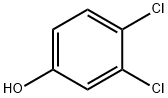
CHEMICAL AND PHYSICAL PROPERTIES
| Physical Description | 3,4-dichlorophenol appears as needles (from benzene, petroleum ether) or light brown and yellow crystals. Odor threshold 100 micrograms/liter. Taste threshold 0.3 micrograms/liter in water. (NTP, 1992) |
|---|---|
| Color/Form | Needles from benzene-petroleum ether |
| Taste | Taste threshold in water: 0.3 ug/l |
| Boiling Point | 488.3 °F at 767 mmHg (NTP, 1992) |
| Melting Point | 151 to 154 °F (NTP, 1992) |
| Solubility | less than 1 mg/mL at 68 °F (NTP, 1992) |
| Vapor Pressure | 0.01 [mmHg] |
| LogP | log Kow = 3.33 |
| Decomposition | When heated to decomposition it emits toxic vapors of /hydrogen chloride/. |
| Odor Threshold | In water: 100 ug/l |
| Dissociation Constants | pKa = 8.63 |
| Kovats Retention Index | 1382 1383 1391 1378 1387 1374 1378 1384 1385 1383.8 |
| Other Experimental Properties | Aqueous solutions of Fenton's reagent iron (2+)+ hydrogen peroxide have been used to affect the total decomposition of the chlorophenols: 2-chlorophenol, 3-chlorophenol, 4-chlorophenol, 3,4-dichlorophenol and 2,4,5-trichorophenol. The mineralization of these chlorinated aromatic substrates to carbon dioxide and free chloride has been studied as a function of iron (2+)+ hydrogen peroxide and perchloric acid. Increasing the concentration of iron (2+)+ hydrogen peroxide enhances the decomposition process, while an increase in the concentration of perchloric acid, inhibits the reaction. The presence of iron (3+) alone without any iron (2+) with hydrogen peroxide has no effect on the degradation of the chlorophenols. In all cases, the stoichiometric quantity of free chloride was obtained at the completion of the decomposition reaction; but the rates of disappearance of the chlorophenol and of the formation of the chloride are not similar. |
| Chemical Classes | Other Classes -> Chlorophenols |
SAFETY INFORMATION
| Signal word | Danger |
|---|---|
| Pictogram(s) |
 Corrosion Corrosives GHS05  Exclamation Mark Irritant GHS07 |
| GHS Hazard Statements |
H302:Acute toxicity,oral H315:Skin corrosion/irritation H318:Serious eye damage/eye irritation |
| Precautionary Statement Codes |
P280:Wear protective gloves/protective clothing/eye protection/face protection. P302+P352:IF ON SKIN: wash with plenty of soap and water. |
COMPUTED DESCRIPTORS
| Molecular Weight | 163.00 g/mol |
|---|---|
| XLogP3 | 3.3 |
| Hydrogen Bond Donor Count | 1 |
| Hydrogen Bond Acceptor Count | 1 |
| Rotatable Bond Count | 0 |
| Exact Mass | 161.9639201 g/mol |
| Monoisotopic Mass | 161.9639201 g/mol |
| Topological Polar Surface Area | 20.2 Ų |
| Heavy Atom Count | 9 |
| Formal Charge | 0 |
| Complexity | 97.1 |
| Isotope Atom Count | 0 |
| Defined Atom Stereocenter Count | 0 |
| Undefined Atom Stereocenter Count | 0 |
| Defined Bond Stereocenter Count | 0 |
| Undefined Bond Stereocenter Count | 0 |
| Covalently-Bonded Unit Count | 1 |
| Compound Is Canonicalized | Yes |
PRODUCT INTRODUCTION
description
3,4-dichlorophenol appears as needles (from benzene, petroleum ether) or light brown and yellow crystals. Odor threshold 100 micrograms/liter. Taste threshold 0.3 micrograms/liter in water. (NTP, 1992)