
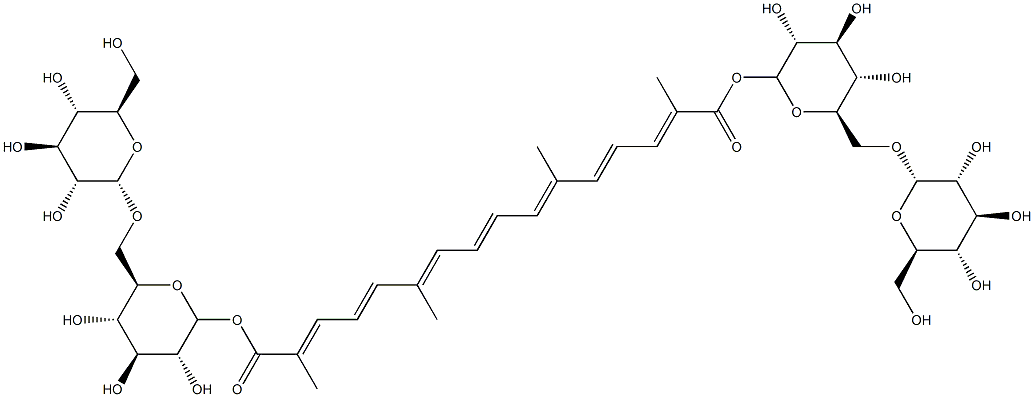
CHEMICAL AND PHYSICAL PROPERTIES
| Physical Description | Solid |
|---|---|
| Color/Form | Solid /Di-gentiobiose ester/ |
| Melting Point | 186 °C (effervescence) /Di-gentiobiose ester/ |
| Solubility | Freely soluble in hot water, giving an orange-colored solution /Di-gentiobiose ester/ |
| Stability/Shelf Life | The kinetics of crocin and picrocrocin in whole and ground samples of saffron stored at different temperatures and relative humidities were studied. First-order kinetics were observed for crocin and second-order for picrocrocin. There was no deterioration of the samples stored at -17 °C or at 0 °C, the ideal storage conditions. A reduction in the relative humidity had a greater effect on stability than a decrease in temperature. Conditions that favor stability for picrocrocin also favor the stability of its aroma. |
COMPUTED DESCRIPTORS
| Molecular Weight | 977.0 g/mol |
|---|---|
| XLogP3 | -2.5 |
| Hydrogen Bond Donor Count | 14 |
| Hydrogen Bond Acceptor Count | 24 |
| Rotatable Bond Count | 20 |
| Exact Mass | 976.37875290 g/mol |
| Monoisotopic Mass | 976.37875290 g/mol |
| Topological Polar Surface Area | 391 Ų |
| Heavy Atom Count | 68 |
| Formal Charge | 0 |
| Complexity | 1730 |
| Isotope Atom Count | 0 |
| Defined Atom Stereocenter Count | 20 |
| Undefined Atom Stereocenter Count | 0 |
| Defined Bond Stereocenter Count | 7 |
| Undefined Bond Stereocenter Count | 0 |
| Covalently-Bonded Unit Count | 1 |
| Compound Is Canonicalized | Yes |
PRODUCT INTRODUCTION
description
Crocin-1 is a diester that is crocetin in which both of the carboxy groups have been converted to their gentiobiosyl esters. It is one of the water-soluble yellow-red pigments of saffron and is used as a spice for flavouring and colouring food. Note that in India, the term 'Crocin' is also used by GlaxoSmithKline as a brand-name for paracetamol. It has a role as an antioxidant, a food colouring, a plant metabolite and a histological dye. It is a diester, a disaccharide derivative and a diterpenoid. It is functionally related to a beta-D-gentiobiosyl crocetin and a gentiobiose.