
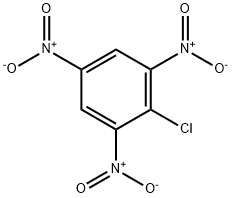
CHEMICAL AND PHYSICAL PROPERTIES
| Physical Description | Picryl chloride appears as a detonating explosive in the form of light yellow needles. Slightly soluble in ether, alcohol, and benzene. Insoluble in water. As insensitive to shock as TNT. Primary hazard is blast of an instantaneous explosion, not flying projectiles or fragments. Under prolonged exposure to fire or heat the containers may explode violently. |
|---|---|
| Color/Form | Almost white needles |
| Melting Point | 181 to 185 °F (NTP, 1992) |
| Solubility | less than 1 mg/mL at 66 °F (NTP, 1992) |
| Density | 1.797 at 68 °F (NTP, 1992) - Denser than water; will sink |
| Vapor Pressure | 0.00000383 [mmHg] |
| Chemical Classes | Nitrogen Compounds -> Nitros, Aromatic |
COMPUTED DESCRIPTORS
| Molecular Weight | 247.55 g/mol |
|---|---|
| XLogP3 | 2.8 |
| Hydrogen Bond Donor Count | 0 |
| Hydrogen Bond Acceptor Count | 6 |
| Rotatable Bond Count | 0 |
| Exact Mass | 246.9632125 g/mol |
| Monoisotopic Mass | 246.9632125 g/mol |
| Topological Polar Surface Area | 138 Ų |
| Heavy Atom Count | 16 |
| Formal Charge | 0 |
| Complexity | 296 |
| Isotope Atom Count | 0 |
| Defined Atom Stereocenter Count | 0 |
| Undefined Atom Stereocenter Count | 0 |
| Defined Bond Stereocenter Count | 0 |
| Undefined Bond Stereocenter Count | 0 |
| Covalently-Bonded Unit Count | 1 |
| Compound Is Canonicalized | Yes |
PRODUCT INTRODUCTION
description
Picryl chloride appears as a detonating explosive in the form of light yellow needles. Slightly soluble in ether, alcohol, and benzene. Insoluble in water. As insensitive to shock as TNT. Primary hazard is blast of an instantaneous explosion, not flying projectiles or fragments. Under prolonged exposure to fire or heat the containers may explode violently.