
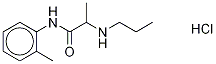
CHEMICAL AND PHYSICAL PROPERTIES
| Collision Cross Section | 154.2 Ų [M+H]+ [CCS Type: TW, Method: calibrated with polyalanine and drug standards] |
|---|
COMPUTED DESCRIPTORS
| Molecular Weight | 256.77 g/mol |
|---|---|
| Hydrogen Bond Donor Count | 3 |
| Hydrogen Bond Acceptor Count | 2 |
| Rotatable Bond Count | 5 |
| Exact Mass | 256.1342410 g/mol |
| Monoisotopic Mass | 256.1342410 g/mol |
| Topological Polar Surface Area | 41.1 Ų |
| Heavy Atom Count | 17 |
| Formal Charge | 0 |
| Complexity | 218 |
| Isotope Atom Count | 0 |
| Defined Atom Stereocenter Count | 0 |
| Undefined Atom Stereocenter Count | 1 |
| Defined Bond Stereocenter Count | 0 |
| Undefined Bond Stereocenter Count | 0 |
| Covalently-Bonded Unit Count | 2 |
| Compound Is Canonicalized | Yes |
PRODUCT INTRODUCTION
description
Prilocaine Hydrochloride is the hydrochloride salt form of prilocaine, an intermediate-acting local anesthetic of the amide type chemically related to lidocaine. Prilocaine hydrochloride binds to voltage-gated sodium ion channels in the neuronal membrane, thereby preventing the permeability of sodium ions. This leads to a stabilization of the neuronal membrane and inhibits depolarization and results in a reversible blockage of nerve impulse generation and propagation along nerve fibres and subsequent reversible loss of sensation.