
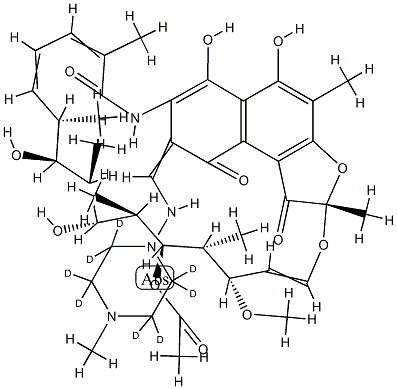
CHEMICAL AND PHYSICAL PROPERTIES
| Color/Form | Red to orange platelets from acetone |
|---|---|
| Odor | ODORLESS |
| Melting Point | Decomposes 183-188 °C |
| Solubility | Freely sol in methyl chloride, dimethyl sulfoxide; sol in tetrahydrofuran; slightly sol in water (pH less than 6), acetone, carbon tetrachloride |
| Vapor Pressure | 3.1X10⁻³⁴ mm Hg at 25 °C /Estimated/ |
| LogP | log Kow = 4.24 /Estimated/ |
| Henry's Law Constant | Henry's Law constant = 2.7X10-42 atm-cu m/mol at 25 °C /Estimated/ |
| Stability/Shelf Life | Very stable in dimethyl sulfoxide; rather stable in water. |
| Dissociation Constants | Zwitterion with pKa 1.7 related to the 4-hydroxy and pKa 7.9 related to the 3-piperazine nitrogen |
| Other Experimental Properties | Very stable in DMSO; rather stable in water. |
COMPUTED DESCRIPTORS
| Molecular Weight | 822.9 g/mol |
|---|---|
| XLogP3 | 4.9 |
| Hydrogen Bond Donor Count | 6 |
| Hydrogen Bond Acceptor Count | 15 |
| Rotatable Bond Count | 5 |
| Exact Mass | 822.40512330 g/mol |
| Monoisotopic Mass | 822.40512330 g/mol |
| Topological Polar Surface Area | 220 Ų |
| Heavy Atom Count | 59 |
| Formal Charge | 0 |
| Complexity | 1620 |
| Isotope Atom Count | 0 |
| Defined Atom Stereocenter Count | 9 |
| Undefined Atom Stereocenter Count | 0 |
| Defined Bond Stereocenter Count | 4 |
| Undefined Bond Stereocenter Count | 0 |
| Covalently-Bonded Unit Count | 1 |
| Compound Is Canonicalized | Yes |
PRODUCT INTRODUCTION
description
A semisynthetic antibiotic produced from Streptomyces mediterranei. It has a broad antibacterial spectrum, including activity against several forms of Mycobacterium. In susceptible organisms it inhibits DNA-dependent RNA polymerase activity by forming a stable complex with the enzyme. It thus suppresses the initiation of RNA synthesis. Rifampin is bactericidal, and acts on both intracellular and extracellular organisms. (From Gilman et al., Goodman and Gilman's The Pharmacological Basis of Therapeutics, 9th ed, p1160)