
CHEMICAL AND PHYSICAL PROPERTIES
| Collision Cross Section | 171.81 Ų [M+H]+ [CCS Type: TW] |
|---|
SAFETY INFORMATION
| Signal word | Warning |
|---|---|
| Pictogram(s) |
 Health Hazard GHS08  Environment GHS09 |
| GHS Hazard Statements |
H373:Specific target organ toxicity, repeated exposure H410:Hazardous to the aquatic environment, long-term hazard |
| Precautionary Statement Codes |
P260:Do not breathe dust/fume/gas/mist/vapours/spray. P273:Avoid release to the environment. P314:Get medical advice/attention if you feel unwell. P391:Collect spillage. Hazardous to the aquatic environment P501:Dispose of contents/container to..… |
COMPUTED DESCRIPTORS
| Molecular Weight | 381.1 g/mol |
|---|---|
| XLogP3 | 4.9 |
| Hydrogen Bond Donor Count | 2 |
| Hydrogen Bond Acceptor Count | 6 |
| Rotatable Bond Count | 2 |
| Exact Mass | 379.9742455 g/mol |
| Monoisotopic Mass | 379.9742455 g/mol |
| Topological Polar Surface Area | 58.2 Ų |
| Heavy Atom Count | 24 |
| Formal Charge | 0 |
| Complexity | 478 |
| Isotope Atom Count | 0 |
| Defined Atom Stereocenter Count | 0 |
| Undefined Atom Stereocenter Count | 0 |
| Defined Bond Stereocenter Count | 0 |
| Undefined Bond Stereocenter Count | 0 |
| Covalently-Bonded Unit Count | 1 |
| Compound Is Canonicalized | Yes |
PRODUCT INTRODUCTION
description
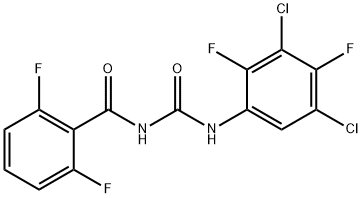
Teflubenzuron is a N-acylurea that is N-carbamoyl-2,6-difluorobenzamide substituted by a 3,5-dichloro-2,4-difluorophenyl group at the terminal nitrogen atom. It has a role as a xenobiotic, an environmental contaminant and an insecticide. It is a dichlorobenzene, a N-acylurea and a difluorobenzene. It is functionally related to a N-benzoylurea.