
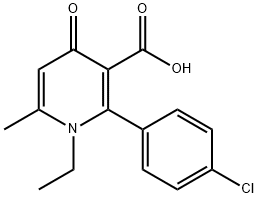
COMPUTED DESCRIPTORS
| Molecular Weight | 291.73 g/mol |
|---|---|
| XLogP3 | 3.6 |
| Hydrogen Bond Donor Count | 1 |
| Hydrogen Bond Acceptor Count | 4 |
| Rotatable Bond Count | 3 |
| Exact Mass | 291.0662210 g/mol |
| Monoisotopic Mass | 291.0662210 g/mol |
| Topological Polar Surface Area | 57.6 Ų |
| Heavy Atom Count | 20 |
| Formal Charge | 0 |
| Complexity | 487 |
| Isotope Atom Count | 0 |
| Defined Atom Stereocenter Count | 0 |
| Undefined Atom Stereocenter Count | 0 |
| Defined Bond Stereocenter Count | 0 |
| Undefined Bond Stereocenter Count | 0 |
| Covalently-Bonded Unit Count | 1 |
| Compound Is Canonicalized | Yes |
PRODUCT INTRODUCTION
description
Karetazan is a member of the class of 4-pyridones that is N-ethyl-4-pyridone that is substituted at positions 2, 3, and 6 by p-chlorophenyl, carboxy, and methyl groups, respectively. It is used (particularly as its potassium salt, known as karetazan-potassium) as a chemical hybridisation agent for commercial hybrid seed production. It is not approved for use within the European Union. It has a role as a chemical hybridisation agent. It is a monocarboxylic acid, a member of monochlorobenzenes, a biaryl and a member of 4-pyridones. It is a conjugate acid of a karetazan(1-).