
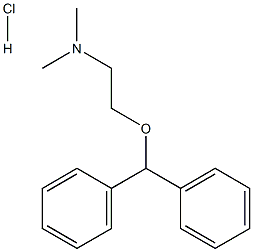
CHEMICAL AND PHYSICAL PROPERTIES
| Physical Description | Diphenhydramine hydrochloride appears as white or almost-white crystalline powder. Odorless with a bitter numbing taste. pH (5% aqueous solution) 4-6. (NTP, 1992) |
|---|---|
| Melting Point | 331 to 338 °F (NTP, 1992) |
| Solubility | >43.8 [ug/mL] (The mean of the results at pH 7.4) |
| Collision Cross Section | 162.7 Ų [M+H]+ [CCS Type: TW, Method: calibrated with polyalanine and drug standards] |
COMPUTED DESCRIPTORS
| Molecular Weight | 291.8 g/mol |
|---|---|
| Hydrogen Bond Donor Count | 1 |
| Hydrogen Bond Acceptor Count | 2 |
| Rotatable Bond Count | 6 |
| Exact Mass | 291.1389920 g/mol |
| Monoisotopic Mass | 291.1389920 g/mol |
| Topological Polar Surface Area | 12.5 Ų |
| Heavy Atom Count | 20 |
| Formal Charge | 0 |
| Complexity | 211 |
| Isotope Atom Count | 0 |
| Defined Atom Stereocenter Count | 0 |
| Undefined Atom Stereocenter Count | 0 |
| Defined Bond Stereocenter Count | 0 |
| Undefined Bond Stereocenter Count | 0 |
| Covalently-Bonded Unit Count | 2 |
| Compound Is Canonicalized | Yes |
PRODUCT INTRODUCTION
description
Diphenhydramine hydrochloride appears as white or almost-white crystalline powder. Odorless with a bitter numbing taste. pH (5% aqueous solution) 4-6. (NTP, 1992)