
78-95-5
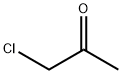
Product Name:
Chloroacetone
Formula:
C3H5ClO
Synonyms:
1-Chloro-2-propanone;1-Chloropropan-2-one;Chloro-2-propanone;Chloroacetone;MCA
Inquiry
CHEMICAL AND PHYSICAL PROPERTIES
| Physical Description | Chloroacetone, stabilized appears as a yellow-colored liquid with an irritating pungent odor. Light sensitive, but stabilized with the addition of small amounts of water and/or calcium carbonate. Slightly soluble in water and denser than water. Vapors much heavier than air. Irritates skin and eyes. Very toxic by ingestion or inhalation. Used to make other chemicals. A lachrymator. |
|---|---|
| Color/Form | Liquid |
| Odor | Pungent odor |
| Boiling Point | 248 °F (120 ° C) |
| Melting Point | -44.5 °C |
| Flash Point | 82 °F |
| Solubility | Miscible with alcohol, ether and chloroform. Soluble in 10 parts water (wet weight) |
| Density | 1.15 g/cu cm at 20 °C |
| Vapor Density | Relative vapor density (air = 1): 3.2 |
| Vapor Pressure | 12.0 [mmHg] |
| LogP | 0.28 |
| Henry's Law Constant | Henry's Law constant = 1.65X10⁻⁵ atm-cu m/mole at 25 °C |
| Stability/Shelf Life | Turns dark and resinifies on prolonged exposue to light, may be stabilized by 0.1% water or 1.0% calcium carbonate. |
| Autoignition Temperature | 610 °C |
| Decomposition | When heated to decomposition it emits highly toxic fumes. |
| Surface Tension | 35.27 dynes/cm at 20 °C |
| Polymerization | The substance will polymerize slowly under the influence of light with fire or explosion hazard. |
| Odor Threshold | Odor Threshold Low: 0.02 [mmHg] Odor Threshold High: 0.39 [mmHg] Odor threshold from CHEMINFO |
| Kovats Retention Index | 677 675 675 653 626.4 627 |
| Other Experimental Properties | Dipole moment: 2.36 debyes in hexane |
| Chemical Classes | Other Classes -> Halogenated Ketones |
SAFETY INFORMATION
| Signal word | Danger |
|---|---|
| Pictogram(s) |
 Flame Flammables GHS02  Skull and Crossbones Acute Toxicity GHS06  Environment GHS09 |
| GHS Hazard Statements |
H226:Flammable liquids H301:Acute toxicity,oral H315:Skin corrosion/irritation H319:Serious eye damage/eye irritation H335:Specific target organ toxicity, single exposure;Respiratory tract irritation H410:Hazardous to the aquatic environment, long-term hazard |
| Precautionary Statement Codes |
P210:Keep away from heat/sparks/open flames/hot surfaces. — No smoking. P273:Avoid release to the environment. P280:Wear protective gloves/protective clothing/eye protection/face protection. P303+P361+P353:IF ON SKIN (or hair): Remove/Take off Immediately all contaminated clothing. Rinse SKIN with water/shower. P305+P351+P338:IF IN EYES: Rinse cautiously with water for several minutes. Remove contact lenses, if present and easy to do. Continuerinsing. |
COMPUTED DESCRIPTORS
| Molecular Weight | 92.52 g/mol |
|---|---|
| XLogP3 | 0.6 |
| Hydrogen Bond Donor Count | 0 |
| Hydrogen Bond Acceptor Count | 1 |
| Rotatable Bond Count | 1 |
| Exact Mass | 92.0028925 g/mol |
| Monoisotopic Mass | 92.0028925 g/mol |
| Topological Polar Surface Area | 17.1 Ų |
| Heavy Atom Count | 5 |
| Formal Charge | 0 |
| Complexity | 42.2 |
| Isotope Atom Count | 0 |
| Defined Atom Stereocenter Count | 0 |
| Undefined Atom Stereocenter Count | 0 |
| Defined Bond Stereocenter Count | 0 |
| Undefined Bond Stereocenter Count | 0 |
| Covalently-Bonded Unit Count | 1 |
| Compound Is Canonicalized | Yes |
PRODUCT INTRODUCTION
description
Chloroacetone, stabilized appears as a yellow-colored liquid with an irritating pungent odor. Light sensitive, but stabilized with the addition of small amounts of water and/or calcium carbonate. Slightly soluble in water and denser than water. Vapors much heavier than air. Irritates skin and eyes. Very toxic by ingestion or inhalation. Used to make other chemicals. A lachrymator.