
CHEMICAL AND PHYSICAL PROPERTIES
| Solubility | >40.8 [ug/mL] (The mean of the results at pH 7.4) |
|---|---|
| Collision Cross Section | 155.8 Ų [M+H]+ [CCS Type: TW, Method: calibrated with polyalanine and drug standards] |
COMPUTED DESCRIPTORS
| Molecular Weight | 271.78 g/mol |
|---|---|
| Hydrogen Bond Donor Count | 3 |
| Hydrogen Bond Acceptor Count | 3 |
| Rotatable Bond Count | 6 |
| Exact Mass | 271.1451400 g/mol |
| Monoisotopic Mass | 271.1451400 g/mol |
| Topological Polar Surface Area | 58.4 Ų |
| Heavy Atom Count | 18 |
| Formal Charge | 0 |
| Complexity | 221 |
| Isotope Atom Count | 0 |
| Defined Atom Stereocenter Count | 0 |
| Undefined Atom Stereocenter Count | 0 |
| Defined Bond Stereocenter Count | 0 |
| Undefined Bond Stereocenter Count | 0 |
| Covalently-Bonded Unit Count | 2 |
| Compound Is Canonicalized | Yes |
PRODUCT INTRODUCTION
description
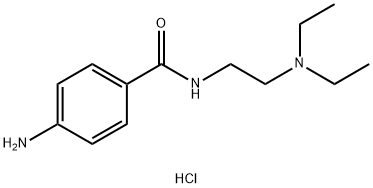
Procainamide Hydrochloride is the hydrochloride salt form of procainamide, an amide derivative exhibiting class 1A antiarrhythmic property and analog of procaine. Procainamide hydrochloride reversibly binds to and blocks activated (open) voltage-gated sodium channels, thereby blocks the influx of sodium ions into the cell, which leads to an increase in threshold for excitation and inhibit depolarization during phase 0 of the action potential. In addition, the effective refractory period (ERP), action potential duration (APD), and ERP/APD ratios are increased, resulting in decreased impulse conduction velocity. The lasting action potential may also be due to blockage of outward K+ currents. The result is a decrease in automaticity, increase in refractory period and slowing of impulse conduction.