
CHEMICAL AND PHYSICAL PROPERTIES
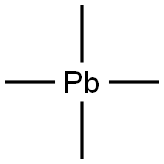
| Physical Description | Tetramethyllead appears as colorless liquid, dyed red, orange or blue. Has a slight musty odor. Used as an antiknock additive for gasolines; component of mixed alkyl leads for gasoline additives. (EPA, 1998) |
|---|---|
| Color/Form | Colorless liquid (/often/ dyed red, orange, or blue /for use in coimmercial gasoline/) |
| Odor | Fruity odor |
| Boiling Point | 230 °F at 10 mmHg Decomposes above 212 °F (EPA, 1998) |
| Melting Point | -17.5 °F (EPA, 1998) |
| Flash Point | 100.4 °F (EPA, 1998) |
| Solubility | Insoluble (NTP, 1992) |
| Density | 1.995 (EPA, 1998) - Denser than water; will sink |
| Vapor Density | 6.5 (EPA, 1998) - Heavier than air; will sink (Relative to Air) |
| Vapor Pressure | 22 mmHg at 68 °F (EPA, 1998) |
| LogP | log Kow = 2.97 |
| Stability/Shelf Life | SOMEWHAT MORE STABLE THAN TETRAETHYL CMPD. |
| Autoignition Temperature | 254 °C |
| Decomposition | Temperatures above 100 °C (212 °F) cause decomposition and development of pressure that may cause containers to burst. |
| Heat of Vaporization | 55.5 Btu/lb = 30.8 cal/g = 1.29x10+5 J/kg (estimated) |
| Refractive Index | Index of refraction: 1.5120 at 20 °C |
| Other Experimental Properties | Standard molar enthalpy of formation at 25 °C = 97.9 kJ/mol (liquid), 135.9 kJ/mol (gas) |
| Chemical Classes | Metals -> Metals, Organic Compounds |
COMPUTED DESCRIPTORS
| Molecular Weight | 267 g/mol |
|---|---|
| Hydrogen Bond Donor Count | 0 |
| Hydrogen Bond Acceptor Count | 0 |
| Rotatable Bond Count | 0 |
| Exact Mass | 268.07055 g/mol |
| Monoisotopic Mass | 268.07055 g/mol |
| Topological Polar Surface Area | 0 Ų |
| Heavy Atom Count | 5 |
| Formal Charge | 0 |
| Complexity | 19.1 |
| Isotope Atom Count | 0 |
| Defined Atom Stereocenter Count | 0 |
| Undefined Atom Stereocenter Count | 0 |
| Defined Bond Stereocenter Count | 0 |
| Undefined Bond Stereocenter Count | 0 |
| Covalently-Bonded Unit Count | 1 |
| Compound Is Canonicalized | Yes |
PRODUCT INTRODUCTION
description
Tetramethyllead appears as colorless liquid, dyed red, orange or blue. Has a slight musty odor. Used as an antiknock additive for gasolines; component of mixed alkyl leads for gasoline additives. (EPA, 1998)