
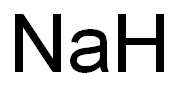
CHEMICAL AND PHYSICAL PROPERTIES
| Physical Description | Sodium appears as a silvery soft metal that becomes grayish white upon exposure to air. Shipped as a solid or molten liquid. Burns violently with explosions that may spatter the material. Used for making gasoline additives, electric power cable, sodium lamps, other chemicals. |
|---|---|
| Color/Form | Light, silvery-white metal; body-centered cubic structure; lustrous when freshly cut; tarnishes on exposure to air, becoming dull and gray; soft at ordinary temperature, fairly hard at -20 °C |
| Boiling Point | 1621 °F at 760 mmHg (USCG, 1999) |
| Melting Point | 207.5 °F (USCG, 1999) |
| Solubility | Insoluble in benzene, kerosene, naphtha |
| Density | 0.971 at 68 °F (USCG, 1999) - Less dense than water; will float |
| Vapor Pressure | 1.2 [mmHg] |
| Stability/Shelf Life | TARNISHES ON EXPOSURE TO AIR, BECOMING DULL & GRAY |
| Autoignition Temperature | 250 °F (USCG, 1999) |
| Decomposition | VIOLENTLY DECOMPOSES WATER, FORMING SODIUM HYDROXIDE & HYDROGEN ... . |
| Viscosity | 0.680 cP at 100 °C; 0.284 cP at 400 °C; 0.820 cP at 550 °C |
| Heat of Vaporization | 3.874X10+6 J/kg at boiling point |
| Surface Tension | 192 dyn/cm at melting point; 161 dyn/cm at 400 °C; 146 dyn/cm at 550 °C |
| Refractive Index | INDEX OF REFRACTION: 4.22 |
| Other Experimental Properties | Atomic weight = 22.989770 |
| Chemical Classes | Metals -> Elements, Metallic |
SAFETY INFORMATION
| Signal word | Danger |
|---|---|
| Pictogram(s) |
 Flame Flammables GHS02  Corrosion Corrosives GHS05  Exclamation Mark Irritant GHS07  Health Hazard GHS08  Environment GHS09 |
| GHS Hazard Statements |
H260:Substances And Mixtures Which, In Contact With Water,Emit Flammable Gases H304:Aspiration hazard H314:Skin corrosion/irritation H336:Specific target organ toxicity,single exposure; Narcotic effects H411:Hazardous to the aquatic environment, long-term hazard |
| Precautionary Statement Codes |
P280:Wear protective gloves/protective clothing/eye protection/face protection. P231+P232:Handle under inert gas. Protect from moisture. P301+P330+P331:IF SWALLOWED: Rinse mouth. Do NOT induce vomiting. P303+P361+P353:IF ON SKIN (or hair): Remove/Take off Immediately all contaminated clothing. Rinse SKIN with water/shower. P305+P351+P338:IF IN EYES: Rinse cautiously with water for several minutes. Remove contact lenses, if present and easy to do. Continuerinsing. |
COMPUTED DESCRIPTORS
| Molecular Weight | 22.9897693 g/mol |
|---|---|
| Hydrogen Bond Donor Count | 0 |
| Hydrogen Bond Acceptor Count | 0 |
| Exact Mass | 22.98976928 g/mol |
| Monoisotopic Mass | 22.98976928 g/mol |
| Topological Polar Surface Area | 0 Ų |
| Heavy Atom Count | 1 |
| Formal Charge | 0 |
| Complexity | 0 |
| Isotope Atom Count | 0 |
| Defined Atom Stereocenter Count | 0 |
| Undefined Atom Stereocenter Count | 0 |
| Defined Bond Stereocenter Count | 0 |
| Undefined Bond Stereocenter Count | 0 |
| Covalently-Bonded Unit Count | 1 |
| Compound Is Canonicalized | Yes |
PRODUCT INTRODUCTION
description
Sodium appears as a silvery soft metal that becomes grayish white upon exposure to air. Shipped as a solid or molten liquid. Burns violently with explosions that may spatter the material. Used for making gasoline additives, electric power cable, sodium lamps, other chemicals.