
727-81-1
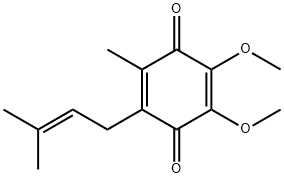
Product Name:
COENZYME Q1
Formula:
C14H18O4
Synonyms:
2,3-Dimethoxy-5-methyl-6-(3-methyl-2-butenyl)-1,4-benzoquinone;Ubiquinone-1;Ubiquinone-5
Inquiry
CHEMICAL AND PHYSICAL PROPERTIES
| Physical Description | Solid |
|---|
COMPUTED DESCRIPTORS
| Molecular Weight | 250.29 g/mol |
|---|---|
| XLogP3 | 2.8 |
| Hydrogen Bond Donor Count | 0 |
| Hydrogen Bond Acceptor Count | 4 |
| Rotatable Bond Count | 4 |
| Exact Mass | 250.12050905 g/mol |
| Monoisotopic Mass | 250.12050905 g/mol |
| Topological Polar Surface Area | 52.6 Ų |
| Heavy Atom Count | 18 |
| Formal Charge | 0 |
| Complexity | 474 |
| Isotope Atom Count | 0 |
| Defined Atom Stereocenter Count | 0 |
| Undefined Atom Stereocenter Count | 0 |
| Defined Bond Stereocenter Count | 0 |
| Undefined Bond Stereocenter Count | 0 |
| Covalently-Bonded Unit Count | 1 |
| Compound Is Canonicalized | Yes |
PRODUCT INTRODUCTION
description
Ubiquinones is any benzoquinone derived from 2,3-dimethoxy-5-methylbenzoquinone; one of a group of naturally occurring homologues. The redox-active quinoid moiety usually carries a polyprenoid side chain at position 6, the number of isoprenoid units in which is species-specific. Ubiquinones are involved in the control of mitochondrial electron transport, and are also potent anti-oxidants. It has a role as an Escherichia coli metabolite and a mouse metabolite. It is a prenylquinone and a member of 1,4-benzoquinones. It is functionally related to a 2,3-dihydroxy-5-methyl-1,4-benzoquinone.