
SAFETY INFORMATION
| Signal word | Warning |
|---|---|
| Pictogram(s) |
 Exclamation Mark Irritant GHS07 |
| GHS Hazard Statements |
H302:Acute toxicity,oral |
COMPUTED DESCRIPTORS
| Molecular Weight | 452.4 g/mol |
|---|---|
| XLogP3 | -0.2 |
| Hydrogen Bond Donor Count | 9 |
| Hydrogen Bond Acceptor Count | 11 |
| Rotatable Bond Count | 6 |
| Exact Mass | 452.13186158 g/mol |
| Monoisotopic Mass | 452.13186158 g/mol |
| Topological Polar Surface Area | 208 Ų |
| Heavy Atom Count | 32 |
| Formal Charge | 0 |
| Complexity | 633 |
| Isotope Atom Count | 0 |
| Defined Atom Stereocenter Count | 5 |
| Undefined Atom Stereocenter Count | 0 |
| Defined Bond Stereocenter Count | 0 |
| Undefined Bond Stereocenter Count | 0 |
| Covalently-Bonded Unit Count | 1 |
| Compound Is Canonicalized | Yes |
PRODUCT INTRODUCTION
description
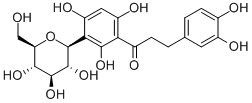
Aspalathin is a member of the class of dihydrochalcones that is the 2-C-beta-D-glucopyranide of phloroglucinol and which is substituted at position 4 by a 3-(3,4-dihydroxyphenyl)propanoyl group. A metabolite of red bush, Aspalathus linearis (and present in the herbal tea made from the leaves), aspalathin exhibits significant hypoglycemic activity. It has a role as a hypoglycemic agent, an EC 1.17.3.2 (xanthine oxidase) inhibitor, an antioxidant and a plant metabolite. It is a C-glycosyl compound, a member of dihydrochalcones, a polyphenol, a polyketide and a member of catechols.