
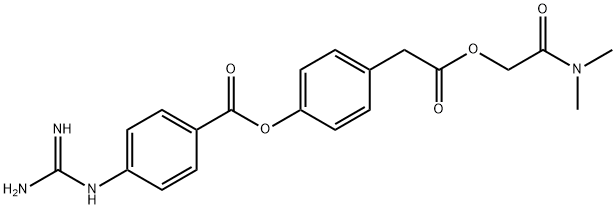
CHEMICAL AND PHYSICAL PROPERTIES
| Melting Point | 194-198 |
|---|
COMPUTED DESCRIPTORS
| Molecular Weight | 398.4 g/mol |
|---|---|
| XLogP3 | 1.1 |
| Hydrogen Bond Donor Count | 2 |
| Hydrogen Bond Acceptor Count | 6 |
| Rotatable Bond Count | 9 |
| Exact Mass | 398.15901982 g/mol |
| Monoisotopic Mass | 398.15901982 g/mol |
| Topological Polar Surface Area | 137 Ų |
| Heavy Atom Count | 29 |
| Formal Charge | 0 |
| Complexity | 602 |
| Isotope Atom Count | 0 |
| Defined Atom Stereocenter Count | 0 |
| Undefined Atom Stereocenter Count | 0 |
| Defined Bond Stereocenter Count | 0 |
| Undefined Bond Stereocenter Count | 0 |
| Covalently-Bonded Unit Count | 1 |
| Compound Is Canonicalized | Yes |
PRODUCT INTRODUCTION
description
Camostat is a benzoate ester resulting from the formal condensation of the carboxy group of 4-guanidinobenzoic acid with the hydroxy group of 2-(dimethylamino)-2-oxoethyl (4-hydroxyphenyl)acetate. It is a potent inhibitor of the human transmembrane protease serine 2 (TMPRSS2) and its mesylate salt is currently under investigation for its effectiveness in COVID-19 patients. It has a role as an anticoronaviral agent, a serine protease inhibitor, an antifibrinolytic drug, an anti-inflammatory agent, an antiviral agent, an antihypertensive agent and an antineoplastic agent. It is a tertiary carboxamide, a carboxylic ester, a diester, a member of guanidines and a benzoate ester. It is functionally related to a 4-guanidinobenzoic acid. It is a conjugate base of a camostat(1+).