
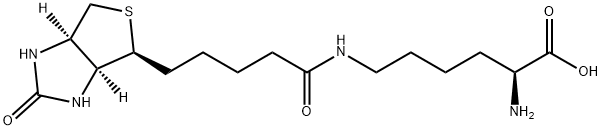
CHEMICAL AND PHYSICAL PROPERTIES
| Physical Description | Solid |
|---|---|
| Melting Point | 243 - 246 °C |
| Collision Cross Section | 186.8 Ų [M+H]+ [CCS Type: DT, Method: single field calibrated with Agilent tune mix (Agilent)] |
COMPUTED DESCRIPTORS
| Molecular Weight | 372.5 g/mol |
|---|---|
| XLogP3 | -2.4 |
| Hydrogen Bond Donor Count | 5 |
| Hydrogen Bond Acceptor Count | 6 |
| Rotatable Bond Count | 11 |
| Exact Mass | 372.18312656 g/mol |
| Monoisotopic Mass | 372.18312656 g/mol |
| Topological Polar Surface Area | 159 Ų |
| Heavy Atom Count | 25 |
| Formal Charge | 0 |
| Complexity | 491 |
| Isotope Atom Count | 0 |
| Defined Atom Stereocenter Count | 4 |
| Undefined Atom Stereocenter Count | 0 |
| Defined Bond Stereocenter Count | 0 |
| Undefined Bond Stereocenter Count | 0 |
| Covalently-Bonded Unit Count | 1 |
| Compound Is Canonicalized | Yes |
PRODUCT INTRODUCTION
description
Biocytin is a monocarboxylic acid amide that results from the formal condensation of the carboxylic acid group of biotin with the N(6)-amino group of L-lysine. It has a role as a mouse metabolite. It is an azabicycloalkane, a thiabicycloalkane, a member of ureas, a monocarboxylic acid amide, a non-proteinogenic L-alpha-amino acid and a L-lysine derivative. It is functionally related to a biotin. It is a tautomer of a biocytin zwitterion.