
538-75-0
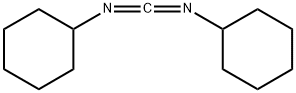
CHEMICAL AND PHYSICAL PROPERTIES
| Physical Description | N,n'-dicyclohexylcarbodiimide is a white crystalline solid with a heavy sweet odor. (NTP, 1992) |
|---|---|
| Color/Form | Crystalline mass |
| Odor | Heavy sweet odor |
| Boiling Point | 252 to 255 °F at 6 mmHg (NTP, 1992) |
| Melting Point | 93 to 95 °F (NTP, 1992) |
| Flash Point | greater than 235 °F (NTP, 1992) |
| Solubility | Reaction (NTP, 1992) |
| Vapor Pressure | VP: 0.5 mm Hg at 98-100 °C, 2 mm Hg at 138-140 °C, 11 mm Hg at 154-156 °C |
| LogP | log Kow = 6.83 (est; value theoretical as compound reacts with water) |
| Decomposition | When heated to decomposition it emits toxic vapors of /oxides of nitrogen/. |
| Corrosivity | Corrosive to tissue |
| Other Experimental Properties | Set point = 29-30 °C |
| Chemical Classes | Nitrogen Compounds -> Other Nitrogen Compounds |
SAFETY INFORMATION
| Signal word | Danger |
|---|---|
| Pictogram(s) |
 Corrosion Corrosives GHS05  Exclamation Mark Irritant GHS07  Health Hazard GHS08 |
| GHS Hazard Statements |
H312:Acute toxicity,dermal H315:Skin corrosion/irritation H317:Sensitisation, Skin H318:Serious eye damage/eye irritation H336:Specific target organ toxicity,single exposure; Narcotic effects H351:Carcinogenicity |
| Precautionary Statement Codes |
P202:Do not handle until all safety precautions have been read and understood. P261:Avoid breathing dust/fume/gas/mist/vapours/spray. P280:Wear protective gloves/protective clothing/eye protection/face protection. P305+P351+P338:IF IN EYES: Rinse cautiously with water for several minutes. Remove contact lenses, if present and easy to do. Continuerinsing. P308+P313:IF exposed or concerned: Get medical advice/attention. |
COMPUTED DESCRIPTORS
| Molecular Weight | 206.33 g/mol |
|---|---|
| XLogP3 | 4.7 |
| Hydrogen Bond Donor Count | 0 |
| Hydrogen Bond Acceptor Count | 2 |
| Rotatable Bond Count | 2 |
| Exact Mass | 206.178298710 g/mol |
| Monoisotopic Mass | 206.178298710 g/mol |
| Topological Polar Surface Area | 24.7 Ų |
| Heavy Atom Count | 15 |
| Formal Charge | 0 |
| Complexity | 201 |
| Isotope Atom Count | 0 |
| Defined Atom Stereocenter Count | 0 |
| Undefined Atom Stereocenter Count | 0 |
| Defined Bond Stereocenter Count | 0 |
| Undefined Bond Stereocenter Count | 0 |
| Covalently-Bonded Unit Count | 1 |
| Compound Is Canonicalized | No |
PRODUCT INTRODUCTION
description
Dicyclohexylcarbodiimide (DCC) is the most popular coupling agent, especially in Merrifield’s SPPS. It is a white crystalline solid with a heavy, sweet odor. It is very reactive and gives a high yield. DCC reacts rapidly with the amino acid or peptide carboxylic acid group to give an O-acylated isourea. The by-product formed is N-acylurea. This reaction has a big disadvantage: it can lead to isomerization and must be used in combination with auxiliary nucleophiles or additives, for example, 1-hydroxybenzotriazole, 3-hydroxy-3,4-dihydro-1,2,3-benzotriazin-4-one, or N-hydroxysuccinimide. A wide variety of solvents can be employed for DCC couplings, including dioxane, DMF, CH3CN, THF, CHCl3, and CH2Cl2. DCC is allergenic and must be handled with great care.