
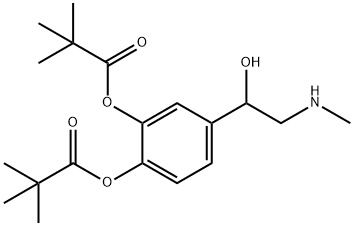
CHEMICAL AND PHYSICAL PROPERTIES
| Physical Description | Solid |
|---|---|
| Melting Point | 146-147 |
| Solubility | Freely soluble as HCl salt |
| LogP | 1.7 |
COMPUTED DESCRIPTORS
| Molecular Weight | 351.4 g/mol |
|---|---|
| XLogP3 | 2.9 |
| Hydrogen Bond Donor Count | 2 |
| Hydrogen Bond Acceptor Count | 6 |
| Rotatable Bond Count | 9 |
| Exact Mass | 351.20457303 g/mol |
| Monoisotopic Mass | 351.20457303 g/mol |
| Topological Polar Surface Area | 84.9 Ų |
| Heavy Atom Count | 25 |
| Formal Charge | 0 |
| Complexity | 463 |
| Isotope Atom Count | 0 |
| Defined Atom Stereocenter Count | 0 |
| Undefined Atom Stereocenter Count | 1 |
| Defined Bond Stereocenter Count | 0 |
| Undefined Bond Stereocenter Count | 0 |
| Covalently-Bonded Unit Count | 1 |
| Compound Is Canonicalized | Yes |
PRODUCT INTRODUCTION
description
Dipivefrin is the dipivalate ester of (+-)-epinephrine (racepinephrine). A pro-drug of epinephrine, the hydrochloride is used topically as eye drops to reduce intra-ocular pressure in the treatment of open-angle glaucoma or ocular hypertension. It has a role as a prodrug, an adrenergic agonist, a sympathomimetic agent, an antiglaucoma drug and an ophthalmology drug. It is a member of ethanolamines and a pivalate ester. It is functionally related to an adrenaline. It is a conjugate base of a dipivefrin(1+).