
51-34-3
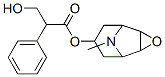
Product Name:
Scopolamine
Formula:
C17H21NO4
Synonyms:
KIAA0606;PHLPP;PHLPP1;PLEKHE1;SCOP
Inquiry
CHEMICAL AND PHYSICAL PROPERTIES
| Physical Description | Scopolamine hydrobromide appears as colorless crystals or white powder or solid. Has no odor. pH (of 5% solution): 4-5.5. Slightly efflorescent in dry air. Bitter, acrid taste. (NTP, 1992) |
|---|---|
| Color/Form | Viscous liquid |
| Melting Point | 387 °F (decomposes) (NTP, 1992) |
| Solubility | greater than or equal to 100 mg/mL at 68 °F (NTP, 1992) |
| LogP | 0.98 |
| Stability/Shelf Life | The commercially available transdermal system of scopolamine should be stored at controlled room temperature between 20 and 25 °C. Scopolamine hydrobromide should be stored in tight, light-resistant containers. Scopolamine hydrobromide injections should be stored in light-resistant, single-dose or multiple-dose containers, preferably of USP Type I glass, at 15 to 30 °C; freezing of the injections should be avoided. Commercially available scopolamine hydrobromide soluble tablets should be stored at controlled room temperature (15 to 30 °C). |
| Optical Rotation | Orthorhombic sphenoidal crystals from water, slightly efflorescent in dry air. MP 195 °C (after drying at 105 °For 3 hrs). Specific optical rotation: -24 to -26 deg at 25 °C/D ( c = 5, calculated on anhydrous basis). UV max (emethanol): 246, 252, 258, 264 nm (A (1%, 1 cm): 3.5, 4.0, 4,5, 3.0). pH of 0.5M solution 5.85. One gram dissolves in 1.5 ML water, 20 mL alcohol. Slightly soluble in chloroform. Practically insoluble in ether. /Hydrobromide trihydrate/ |
| Ionization Efficiency | Positive |
| Caco2 Permeability | -4.93 |
| Dissociation Constants | 7.75 |
| Collision Cross Section | 171.1 Ų [M+H]+ [CCS Type: TW, Method: Major Mix IMS/Tof Calibration Kit (Waters)] |
| Other Experimental Properties | Crystals. Freely soluble in water, dilute alcohol; slightly soluble in absolute alcohol /Methyl nitrate/ |
SAFETY INFORMATION
| Signal word | Danger |
|---|---|
| Pictogram(s) |
 Corrosion Corrosives GHS05  Skull and Crossbones Acute Toxicity GHS06 |
| GHS Hazard Statements |
H317:Sensitisation, Skin H318:Serious eye damage/eye irritation |
| Precautionary Statement Codes |
P260:Do not breathe dust/fume/gas/mist/vapours/spray. P262:Do not get in eyes, on skin, or on clothing. P280:Wear protective gloves/protective clothing/eye protection/face protection. P305+P351+P338:IF IN EYES: Rinse cautiously with water for several minutes. Remove contact lenses, if present and easy to do. Continuerinsing. |
COMPUTED DESCRIPTORS
| Molecular Weight | 303.35 g/mol |
|---|---|
| XLogP3 | 0.9 |
| Hydrogen Bond Donor Count | 1 |
| Hydrogen Bond Acceptor Count | 5 |
| Rotatable Bond Count | 5 |
| Exact Mass | 303.14705815 g/mol |
| Monoisotopic Mass | 303.14705815 g/mol |
| Topological Polar Surface Area | 62.3 Ų |
| Heavy Atom Count | 22 |
| Formal Charge | 0 |
| Complexity | 418 |
| Isotope Atom Count | 0 |
| Defined Atom Stereocenter Count | 5 |
| Undefined Atom Stereocenter Count | 0 |
| Defined Bond Stereocenter Count | 0 |
| Undefined Bond Stereocenter Count | 0 |
| Covalently-Bonded Unit Count | 1 |
| Compound Is Canonicalized | Yes |
PRODUCT INTRODUCTION
description
Scopolamine hydrobromide appears as colorless crystals or white powder or solid. Has no odor. pH (of 5% solution): 4-5.5. Slightly efflorescent in dry air. Bitter, acrid taste. (NTP, 1992)